English
 Español
A product manager spreads three samples across a meeting table: a 50 ml frosted glass jar with a bamboo lid, a 50 ml jar moulded from post-consumer recycled polypropylene, and a refill pod that clips into a reusable outer shell. All three arrive with supplier emails describing them as sustainable. Only one will usually survive a serious sustainability review, and it is rarely the one that looks greenest.
The most eco-friendly packaging for cosmetics is, in most cases, a mono-material container with a high proportion of verified post-consumer recycled (PCR) content, refillable or at least designed to pass cleanly through a standard recycling stream, right-sized to the real dose, and decorated without elements that block sorting. For a face cream that usually means a PP or PCR-PP jar. For a serum, an airless PP or PET bottle. For a cleanser, a mono-material foam pump bottle. Glass and aluminium can outperform plastic when they are reused many times or recycled in a closed loop, but they lose that advantage when a heavy jar travels thousands of kilometres to protect 15 ml of product.
The rest of this guide explains how to reach that conclusion for your own SKU, what evidence to demand from a supplier, and where the popular alternatives quietly fail.
The Short Answer, Written as Seven Selection Rules
If you have to make a decision this week, apply these rules in order. They settle most internal debates faster than commissioning a life-cycle assessment, and they rarely point in the wrong direction.
- Keep the pack to one material family. A PP bottle with a PP pump, PP collar and PP cap travels through the recycling stream as one item. Replace the pump with a version containing a steel spring or add a metallised collar, and you have created components that most sorting facilities will not separate.
- Ask for certified recycled content, not a verbal promise. PCR resin should come with traceability documentation, batch-level declarations, or third-party certification such as EuCertPlast, ISCC PLUS or an equivalent scheme. "Eco plastic" in a spec sheet means nothing on its own.
- Build a refill or reuse path where volumes justify it. A refill that is 60 to 80 percent lighter than the primary pack delivers a measurable reduction, provided the outer shell survives at least three to five refill cycles in normal use.
- Right-size the pack against the dose. A 200 ml bottle holding a 30 ml serum is not premium, it is material waste. Conversely, an under-sized pack that forces consumers to buy twice as often usually performs worse than a slightly heavier pack used once.
- Choose decoration that survives the sorting line. Direct printing, in-mould labelling and water-based coatings are compatible with mono-material recycling. Full-body shrink sleeves, metallised films and dark carbon-black pigments are not.
- Drop the "eco additive" story. Oxo-degradable additives and enzyme-based "landfill biodegradation" claims are banned or restricted in several markets and contaminate recycled streams. They add cost and legal risk without adding value.
- Match the format to the formula. An airless pump is the greenest choice for a retinol serum and a wasteful one for a body scrub. Packaging only earns its footprint if it protects the product inside it.
None of these rules is exotic. What makes them difficult is that they interact: a refillable glass jar with a bamboo lid fails rule one, rule three and rule five at the same time, while a plain PCR-PP jar with a PP lid satisfies all seven.
What "Eco-Friendly" Has to Mean Before You Compare Anything
Two suppliers can both call a pack eco-friendly and both be telling the truth about different things. One means the material is recyclable in theory. The other means the pack uses 40 percent less plastic than the previous version. A third means the resin is plant-based. Before you compare options, fix the metrics you are actually measuring.
Carbon per unit sold, not per gram of packaging
Material choice, pack weight, transport distance and the number of units a consumer buys all feed into the same number. A 120 g glass jar shipped from Asia to Europe carries a materially higher transport burden than a 35 g PCR-PP jar of the same capacity. Published life-cycle studies for cosmetic products generally put packaging in the minority of total product emissions, often in the single digits to low teens as a percentage, with the formula, manufacturing and consumer use phase dominating. That does not make packaging irrelevant; it makes packaging the part you can actually change within one development cycle.
Recovery, measured against real infrastructure
"Recyclable" should mean recyclable in the markets where you sell. PET and HDPE bottles are collected almost everywhere. PP is well established in European and North American rigid packaging streams. Coloured and dark plastics are less reliably sorted. Small formats under 50 ml frequently fall through the screen at sorting facilities, which is a strong argument for refill systems in sample and travel sizes.
Product waste, which is usually ignored
A pump that leaves 8 percent of a formula stuck in the bottle wastes more value than the packaging itself weighs. Airless dispensers, inverted disc-top bottles and well-engineered tubes recover more product per unit, and that reduction repeats every time a customer repurchases.
Material efficiency per delivered dose
Divide total pack weight by the number of applications it delivers. A 50 g jar with a thick wall and an aluminium inner cup can weigh three times a comparable PCR-PP jar while delivering the same number of uses. Present that ratio in your packaging brief and the specification conversation becomes much shorter.
The Material Comparison: What Each Option Actually Delivers
The table below ranks common cosmetic packaging materials on the criteria that matter in a real specification review. Ratings assume a typical 50 ml skincare pack and mainstream disposal infrastructure in Europe or North America; they will shift in markets with different collection systems.
| Material | Recycled content available | End-of-life reality | Weight and transport | Best-fit applications |
|---|---|---|---|---|
| PET (virgin) | High, bottle-grade rPET widely available | Strong collection and bottle-to-bottle recycling | Light | Toners, sprays, cleansers, shampoo |
| PCR-PET | 30 to 100 percent, food-grade streams available | Same as PET; watch colour and odour variation | Light | Clear or frosted bottles where clarity matters |
| PP mono-material | PCR-PP increasingly available, quality varies | Good in rigid PP streams; hinges, caps and pumps must also be PP | Light | Jars, airless pumps, caps, closures |
| Glass | High cullet content possible | Effectively infinitely recyclable, but energy-intensive to melt | Heavy, high transport emissions | Prestige creams, perfume, products sold locally |
| Aluminium | High, well-established secondary market | High value recycling, but composite liners and coatings complicate recovery | Light per unit | Tubes, refill pods, deodorant casings |
| Bamboo and wood | Not applicable | Usually laminated, glued or coated; rarely recyclable, not compostable in home systems | Moderate to heavy | Decorative caps and lids where the look earns its cost |
| Wheat-straw filled PP | Filler replaces some virgin polymer | Not compostable; filler disrupts some recycling streams | Light | Marketing-led ranges; verify with your recycler first |
| PLA and compostable blends | Plant-based feedstock | Requires industrial composting, which cosmetic packs rarely reach | Light | Niche launches with a dedicated take-back scheme |
| Paper and moulded pulp | High recycled fibre content | Recyclable if uncoated; plastic liners and barriers often defeat it | Light | Outer cartons, inserts, secondary packaging |
The pattern is consistent. Materials with an established recycling stream and a credible recycled-content supply chain win on measured impact. Materials that depend on a specific end-of-life condition, such as industrial composting, lose in practice because that condition almost never occurs for a shampoo bottle.
Why Glass and Aluminium Are Not Automatically the Winners
Glass and aluminium both carry a fair claim to being infinitely recyclable, and both get recommended constantly in sustainability guides. The claim is accurate; the conclusion drawn from it usually is not.
Glass is heavy and energy-intensive to melt. A 50 ml glass cream jar commonly weighs 120 to 180 g with its lid, against 30 to 45 g for a comparable PP jar. Shipping that difference across an ocean, then melting the glass at around 1,400 to 1,500 degrees Celsius, produces a footprint that a lightweight PCR-PP jar will often beat unless the glass is reused or recycled locally in a high-cullet loop. Glass is the stronger choice when the product is made and sold in the same region, when the brand runs a returns scheme, or when the jar is a prestige object the customer keeps.
Aluminium performs better on weight, and its scrap value makes it one of the few packaging materials that is genuinely recycled for economic reasons. The weak point is the detail: internal lacquers, plastic liners, pump mechanisms and mixed-material closures all reduce recovery yields. An aluminium refill pod in a reusable shell is one of the better sustainability stories in beauty, provided the shell is durable enough to survive multiple cycles and the pod is accepted by the recycling stream it lands in.
The practical test is straightforward. Ask what happens to the pack in the customer's kitchen bin, not what happens in a laboratory. If the answer requires the customer to disassemble the pack, post it somewhere, or find an industrial composting facility, assume the pack will end up in landfill and compare on that basis.
Why "Biodegradable" and Bio-Based Labels Often Fail in Practice
Three phrases cause more confusion in cosmetic packaging than any others: biodegradable, compostable and plant-based. They describe chemistry, not disposal outcomes.
A material certified to EN 13432 or ASTM D6400 composts under industrial conditions of sustained heat and microbial activity. A jar dropped into a household garden, a river or a landfill will not experience those conditions and will behave much like conventional plastic for years. Blends marketed as biodegradable without a recognised certification should be treated as unverified. Several jurisdictions have already restricted oxo-degradable additives because they fragment into microplastics rather than breaking down biologically.
Wheat straw and bamboo fibre fillers are a separate case. They reduce the share of virgin polymer in the part and give the moulding a natural, tactile finish that photographs well. They are not compostable in any meaningful consumer sense, and the filler can complicate mechanical recycling of PP. If you use them, be honest in the claim: "contains plant-based filler" is defensible; "biodegradable" is not.
Plant-based polyethylene and bio-attributed PP have a real role, because they drop into existing recycling streams and can lower the fossil carbon content of a pack. Ask for mass-balance certification, otherwise the percentage figure is unverifiable. And remember that a bio-based bottle is still a bottle: it needs to be collected and reprocessed like any other.
Design Decisions That Outweigh the Material Choice
In most packaging reviews, two packs of the same material will differ in impact by a wider margin than two packs of different materials. Design dominates.
Removing one component
A typical lotion pump has historically contained a steel spring, a glass or steel ball and a mix of PP and PE parts. Mono-material pumps that replace the spring with a TPE component now allow the entire dispenser to be recycled alongside the bottle. The same logic applies to caps: a single-material flip-top cap outperforms a cap with an aluminium shell and a plastic insert, even if the second one photographs better.
Refill and reuse architecture
Refills work when the refill is genuinely lighter and the outer pack survives. A refill pouch or pod that weighs 20 percent of the original and clips in without tools is a defensible system. A refill that is 75 percent of the original weight and requires the customer to clean the shell is not. Design for at least three to five cycles, specify the durability of the closure and the pump thread, and test the refill engagement for at least a thousand cycles in the lab if the mechanism is new.
Lightweighting without breaking performance
Wall thickness reductions of 10 to 15 percent are often achievable on injection-moulded jars and bottles without a visible quality loss, but they change top-load strength and drop performance. Re-run your transit test after any weight reduction; a pack that cracks in e-commerce shipping undoes the savings in a single return.
Correct sizing and the dose ratio
Match the fill volume to the labelled dose and the realistic usage period. A 15 ml eye cream in a 50 ml jar is both a fill-line problem and a material problem. Equally, a 30 ml bottle that delivers three months of use is more efficient than a 100 ml bottle that oxidises before it is finished.
Barrier performance as a waste-reduction tool
Airless and vacuum formats protect oxygen-sensitive actives such as retinoids, vitamin C and certain peptides, and they reduce residual product. If the packaging choice extends shelf life or prevents a formula failure, it has prevented a far larger waste stream than the pack itself represents.
Matching the Format to the Formula
The most sustainable format is the one the formula can live in without a second protective layer. Four routes cover most of the market.
Airless pumps for actives. A 15 to 50 ml airless bottle in PP or PCR-PP protects oxygen-sensitive cream and serum without an inner pouch, dispenses close to the last gram and can be built in mono-material construction with a TPE spring. This is the format most often specified for retinol, vitamin C, foundation and sunscreen.
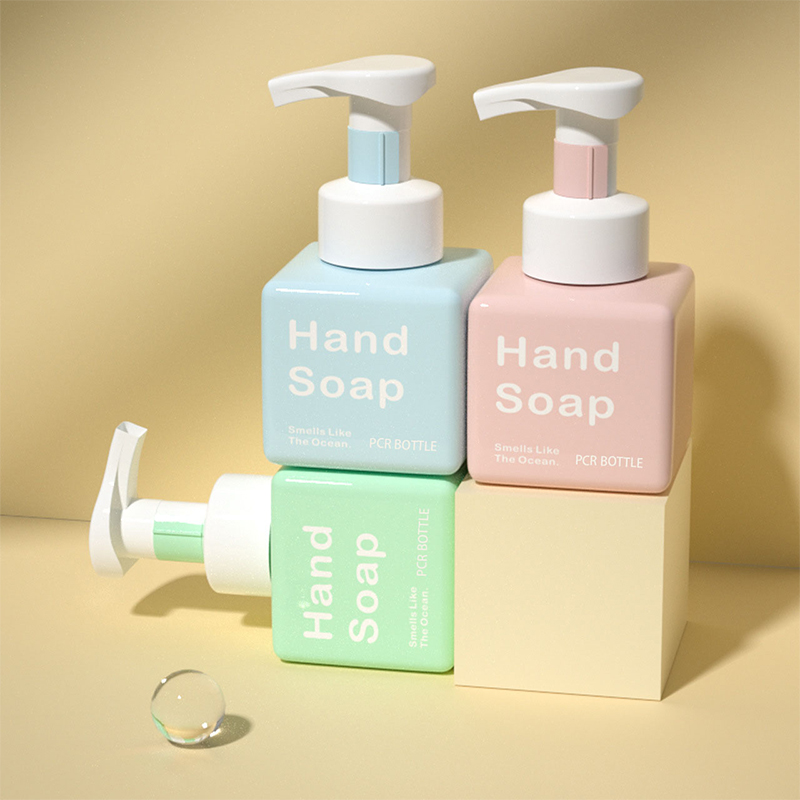 Refillable PCR Foam Pump Cleanser Bottle, 250 mlA 250 ml square refillable bottle with foam pump and screw-cap sealing, suited to facial cleanser or hand wash; PCR construction supports reduced plastic use.View Product →
Foam pumps for cleansers and hand wash. A 150 to 300 ml PCR-PET or PCR-PP foam pump bottle replaces a heavier gel bottle and reduces water consumption at the point of use, because the formula is diluted by the pump rather than in the fill. Refillable versions with a screw-off head let a household keep one outer shell for years.
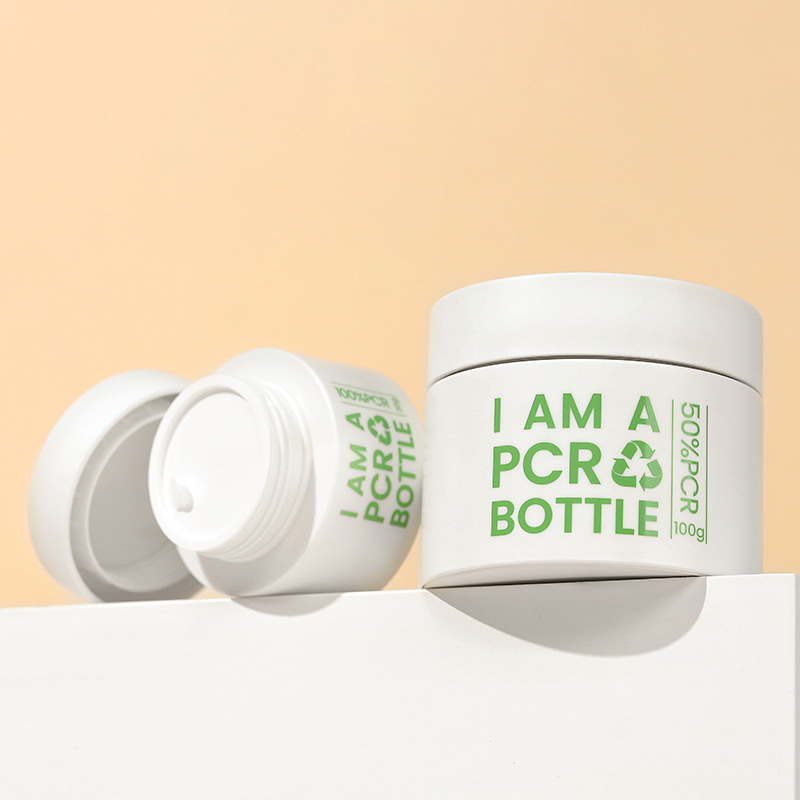 Refillable PCR PP Cosmetic Jars for Creams and BalmsAvailable in 30 g, 50 g and 100 g, these replaceable PCR PP jars suit creams, balms and scrubs, keeping the outer jar in service.View Product →
Refillable jars for creams and balms. A 30 to 100 g PCR-PP jar with a replaceable inner cup keeps the outer wall and lid in service while the product-contacting element is swapped. This is the easiest refill model to communicate at retail and the easiest to recycle, because both parts are the same polymer family.
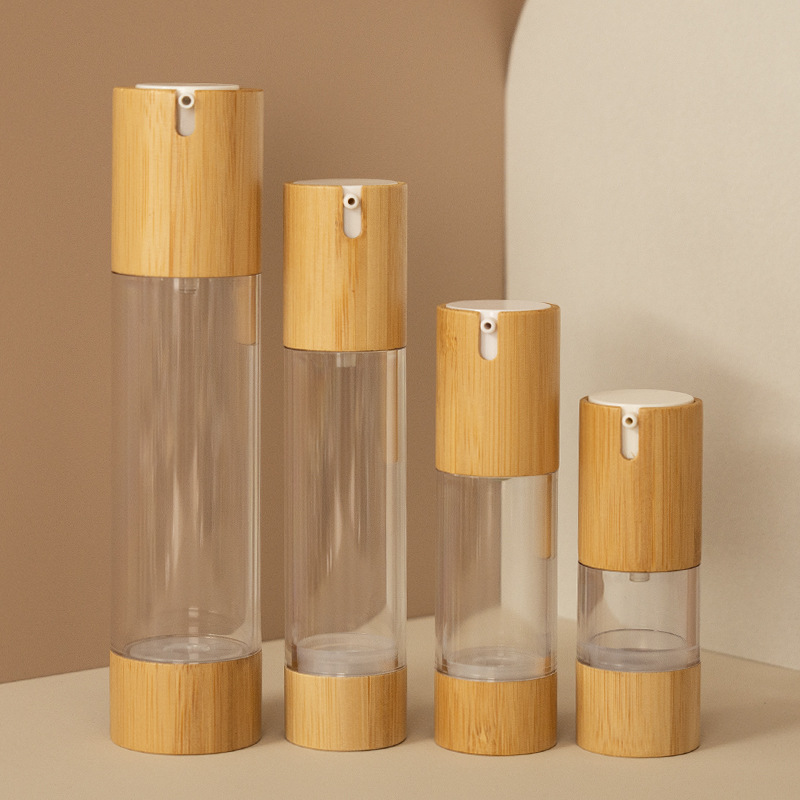
Hybrid wood-and-plastic constructions for premium ranges. A bamboo-clad airless bottle or a bamboo lid on an aluminium inner cup gives the natural look that brands want in the prestige tier. Treat it as a decorative decision rather than an environmental one: the plastic or aluminium body still does the functional work, and the bamboo element should be separable or clearly disclosed.
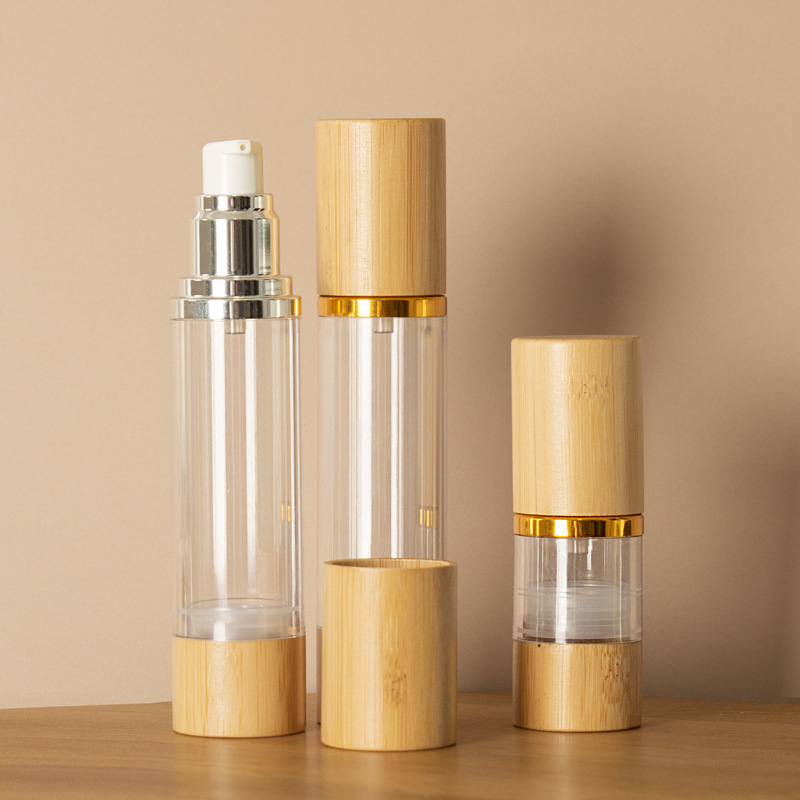 Bamboo Airless Pump Lotion Bottle for Premium PackagingA bamboo-clad airless bottle in 15–120 ml sizes for lotions and emulsions; the pump dispenses product without exposing it to air, suiting premium ranges.View Product →
For oils and serums, a glass dropper bottle remains defensible because the format is small, the product is used slowly, and glass is inert against essential oils. For body care, PET and HDPE squeeze bottles with disc-top caps outperform almost everything on material efficiency per litre. For deodorant, a twist-up stick in PCR-PP avoids the mixed-material construction of a roll-on with a steel ball.
Decoration, Labels and the Sorting Problem
Decoration is where otherwise sound packaging specifications fall apart. A full-body shrink sleeve on a PET bottle is technically recyclable packaging rendered non-recyclable in one production step, because near-infrared sorting equipment cannot see the bottle through the sleeve and wash-off lines are not designed for it.
Preferable options, in rough order of compatibility: in-mould labelling on PP jars and tubs, which keeps the label in the same polymer family; direct screen printing or hot stamping on the container itself; water-based coatings instead of film lamination on cartons; paper labels with water-based adhesive on the container body, sized to leave the shoulder and base clear for sorting.
Colour matters more than most briefs acknowledge. Carbon black pigments absorb the infrared light used by sorting equipment and are effectively invisible to it, so a black bottle is far less likely to be recovered than a white or clear one. Wherever the design permits, move away from carbon black, metallised finishes and heavy full-coverage coatings. If you need a premium metallic look, a coloured PCR resin or a moulded texture usually achieves more, with fewer downstream consequences, than electroplating.
For brands exporting to Europe, decoration also has to survive the direction of travel in packaging regulation: recyclability requirements, minimum recycled content in plastic packaging and restrictions on unnecessary secondary packaging are phasing in this decade. A design review that anticipates those rules is cheaper than a redesign after launch.
What to Verify With a Supplier Before You Commit
Supplier claims are the weakest link in most sustainability programmes. Ask for the following, in writing, before tooling is cut.
- Material declaration with grade and supplier. Polymer type, melt flow index and any filler content, stated per component rather than for the pack as a whole.
- Recycled content evidence. Batch certificates or mass-balance documentation for PCR resin, plus the actual percentage per part. Be explicit about whether the figure covers the body only or the complete pack.
- A mono-material statement. Component-by-component material list for bottle, pump, collar, cap, label and any liner or seal. Mark the parts that differ.
- Recyclability assessment. A RecyClass or APR design-guide evaluation, or an equivalent third-party review, showing which components would need to be separated and how the pack scores on the applicable stream.
- Transit and compatibility testing. Drop, compression and compatibility results to the relevant standard for your channel, including a re-test after any lightweighting. E-commerce channels need a higher drop height than retail shelf distribution.
- Refill cycle data. If the pack is refillable, cycle-test results for the closure, thread and pump engagement, plus a cleaning instruction that a consumer can realistically follow.
- Consistency samples at production scale. PCR resin varies in colour and odour between batches. Ask for three production lots and check them under the lighting your customer will see.
- Surface treatment specification. Spraying, UV coating, silk printing, hot stamping and labelling all change the recyclability profile. Get the process and coverage documented, not just the visual sample.
A supplier that answers all eight without hesitation is worth a longer conversation. One that answers three and changes the subject will cost you the same tooling money and considerably more reputational risk.
Cost, MOQ and Lead Time: The Real Trade-offs
Sustainable specifications carry commercial consequences that are easier to plan for when they are named in advance. The table below summarises the usual pattern for a mid-sized brand ordering 30,000 to 100,000 units.
| Route | Unit cost index | Typical MOQ pressure | Lead-time sensitivity | Main commercial risk |
|---|---|---|---|---|
| Virgin PET or PP stock bottle | Low | Low, stock moulds available | Low | Weak sustainability story |
| PCR-PET or PCR-PP with custom mould | Medium | Medium, tooling amortisation drives volume | Medium, PCR resin lead times vary | Colour and odour variation between lots |
| Mono-material airless pump | Medium to high | Medium to high, multi-component assembly | Medium | Dose and leak performance must be validated |
| Refill system with durable outer shell | High upfront, lower per refill | High, two moulds and an assembly line | High, tooling and validation take longer | Consumer adoption and refill availability |
| Glass with decorative closure | High | Medium | High, freight weight and breakage | Transport cost and breakage claims |
| Bamboo-clad or wood-accent packs | Medium to high | Medium, natural material supply fluctuates | High, colour matching across natural lots | Claims scrutiny and recyclability questions |
Two planning notes are worth carrying into the budget conversation. First, PCR resin pricing has become more volatile than virgin resin in several markets, so lock a price formula rather than a fixed number for a twelve-month programme. Second, refill systems rarely pay back on the packaging line alone; they pay back through repeat purchase rates and through the customer relationship that a durable outer shell creates. Model the whole programme, not the first order.
Lead times on sustainable specifications are usually driven by tooling and validation, not by the resin itself. A custom mono-material airless pack typically needs tooling, sampling, compatibility testing and a production run before it is safe to launch. Budget eight to sixteen weeks beyond a stock-pack timeline and you will avoid most of the schedule surprises.
A Practical Path from Brief to Production
Most brands that get this right follow a similar sequence, and most that get it wrong skip the second step.
- Write the sustainability brief with numbers: target pack weight in grams per unit sold, recycled content percentage per component, recyclability outcome in your two largest markets, and a refill target if applicable.
- Screen formats against the formula before designing anything. Viscosity, pH, actives, preservative system and fill temperature determine whether an airless pump, a jar or a tube is viable. Design decisions taken after formulation lock are expensive.
- Choose the material family and confirm the recycling stream it will meet in each market. If the answer is "industrial composting only", reconsider.
- Select the decoration route at the same time as the container, not after. Printing, coating and labelling all affect whether the pack can be recycled as designed.
- Build a physical sample set across three production lots and test colour, dose, leakage, drop and compression before approving.
- Run a limited launch, measure refill take-up and return rates, then scale the specification that demonstrably works.
This sequence also produces the evidence you will need for on-pack claims. Regulators in Europe and several other markets now require environmental claims to be substantiated and specific, and vague phrasing such as "eco-friendly bottle" is exactly the kind of claim that attracts scrutiny. "Bottle body made with 50 percent post-consumer recycled PP, recyclable where facilities exist" is defensible, verifiable and, in practical terms, more persuasive to a trade buyer than a leaf icon.
Where a Manufacturing Partner Fits Into the Decision
Most of the choices above are made long before a purchase order exists, and they are easier to make with a supplier that can mould, assemble and decorate in one place rather than handing your specification through three vendors. Shaoxing Roman Plastic Co., Ltd., a packaging and beauty-tool manufacturer based in Shangyu, Zhejiang, operates an integrated design, moulding, assembly and inspection setup with more than 50 injection moulding machines and 15 assembly and packing lines, and works on OEM and ODM programmes for skincare and personal care brands.
For a mono-material brief, that integration matters in specific ways. Silkscreen printing, hot stamping, spraying, UV coating and labelling can be specified alongside the container rather than sourced separately, which makes it far easier to keep decoration compatible with the recycling route you have chosen. The company's environmental range covers PCR bottles, refillable airless packs and jars with replaceable inner cups, alongside bamboo-accented and glass formats for prestige lines, so a category can be specified without mixing incompatible systems. Buyers working through the technical distinctions between recycled feedstocks will find a useful primer in this explanation of the difference between PCR and rPET before locking a resin specification.
The point is not that one supplier solves sustainability. The point is that fewer handoffs mean fewer places for a specification to degrade between the brief and the shipped carton.
Coming back to the three samples on the table: the glass jar with the bamboo lid tells a good story and carries the heaviest footprint per use. The refill pod is the strongest option if the outer shell is genuinely durable and the refill is easy to buy. The PCR-PP jar wins on the criteria that survive scrutiny, because it is one material, it contains verified recycled content, it can be recycled in streams that exist today, and it weighs a fraction of the alternative.
That is the practical answer to the question. Not a single miracle material, but a design discipline: one polymer family, certified recycled content, a refill path where the volume justifies it, decoration that does not defeat sorting, and a pack sized to the dose it delivers. Get those five right and the marketing claim writes itself, with evidence behind it.