English
 Español
Ask five people what a skincare bottle is and you will get five different pictures, yet only one variable genuinely decides which bottle a formula needs: the viscosity of the product going inside it, and how sensitive that product is to air. Shape, colour, cap style and decoration all sit downstream of that decision, not upstream of it.
Skincare bottles sort into six working families once you organise them by how they dispense: airless pumps, lotion pumps, foam pumps, spray and mist dispensers, droppers, and simple closures such as disc tops and flip lids. Inside those families sit dozens of sub-types — refillable airless cartridges, continuous spray, syringe-shaped ampoule bottles, twist-up sticks — but they all run on the same engineering logic.
This guide follows the order a packaging team usually evaluates them: what the dispenser does, which formulas fit, which capacities make commercial sense, which materials hold up, how neck finishes and closures must line up, and where projects most often go wrong. Every decision gets easier when it is tied to a measurable number — dose per stroke, viscosity in centipoise, neck diameter in millimetres, residual product left behind — rather than to a photo on a mood board.
How to Read a Skincare Bottle: Four Specifications That Decide Everything
A bottle is not one part. It is a system of three: the body, the closure, and the decoration applied to both. When a brand says "we need a 50 ml serum bottle," they have described roughly one tenth of the specification. The remaining nine tenths live in four numbers:
- Dispenser type and dose per stroke. An airless pump that delivers 0.25 ml per press behaves nothing like a lotion pump delivering 1.0 ml, even if the bottles look similar on a shelf.
- Neck finish. The 24/410, 24/415, 18/415 and 28/410 designations are not decorative. They define whether a pump from one factory will actually screw onto a bottle from another.
- Material and wall thickness. PET, PETG, PP, HDPE, glass and PCR plastics differ in chemical resistance, gloss, weight and cost. Wall thickness decides whether a bottle feels premium or flimsy.
- Nominal capacity versus usable fill. A "200 ml" foam bottle rarely holds 200 ml of liquid. Foaming pumps need air space, and airless bottles need room for the piston to travel.
Get those four right and the rest is styling. Get them wrong and no amount of soft-touch coating will rescue a launch. The table below is the fast version of the whole topic.
| Bottle type | Typical capacity | Best-fit formulas | What it solves |
|---|---|---|---|
| Airless pump | 5–120 ml | Retinol, vitamin C, foundation, sunscreen, eye cream | Blocks air contact; evacuates almost all product |
| Lotion pump | 30–1000 ml | Body lotion, cleanser, shampoo, micellar water | One-hand dosing of medium-viscosity liquids |
| Foam pump | 50–500 ml | Facial cleanser, hand soap, mousse, baby wash | Turns thin liquid into aerated foam without propellant |
| Fine mist spray | 30–200 ml | Toner, setting spray, hair mist, sunscreen mist | Even coverage over a wide area |
| Continuous spray | 80–250 ml | Sunscreen, tanning oil, salon styling spray | Sustained spray without repeated pumping |
| Dropper / pipette | 5–50 ml | Serum, facial oil, essential oil blends | Measured drops and a visible fill level |
| Disc cap | 100–500 ml | Shampoo, shower gel, conditioner | Inverted storage with single-hand squeeze dispensing |
| Flip lid | 100–500 ml | Toner, shampoo, body wash | Low cost, snaps shut, nothing to prime |
| Syringe / ampoule | 5–30 ml | Eye cream, ampoule, whitening gel | High dosing precision and a clinical shelf presence |
| Twist-up stick | 6–75 ml | Deodorant, sunscreen stick, body balm | Direct application with no contact with hands |
Airless Pump Bottles: Sealed Dispensing for Oxygen-Sensitive Formulas
Airless bottles contain no dip tube. A piston sits under the product and rises as the pump draws material out, so the formula never touches air until it leaves the nozzle. For a retinol serum, a stabilised vitamin C, or a foundation built on volatile silicones, that single mechanical difference is often worth more than any claim on the front label.
The numbers that matter are dose per stroke and residual product. A 15 ml airless for eye cream typically dispenses 0.15 ml per press; a 30 ml serum bottle lands around 0.25 ml; a 50 ml foundation or sunscreen format usually runs 0.35 to 0.5 ml. Residual product left in a well-designed airless bottle is commonly under 5 percent, compared with 5 to 10 percent that a dip-tube pump can leave unreachable at the bottom of a conventional bottle.
Airless formats also demand more from the formula and from the project plan. Anything with large exfoliating particles — pumice, jojoba beads, coarse salt — can block the one-way valve. Extremely stiff balms above roughly 50,000 cP may not move through the channels at all. And because the piston must travel the full body length, the fill volume has to be planned against the internal geometry, not against the printed number on the bottle.
Two engineering options have changed the category in recent years. The first is the refillable airless: the inner cartridge is replaced and the decorated outer shell is kept, which cuts packaging waste without changing the consumer's routine. The second is the mono-material airless built entirely from PP with a TPE spring in the pump, replacing the metal spring that traditionally prevents the whole assembly from being processed in a single recycling stream.
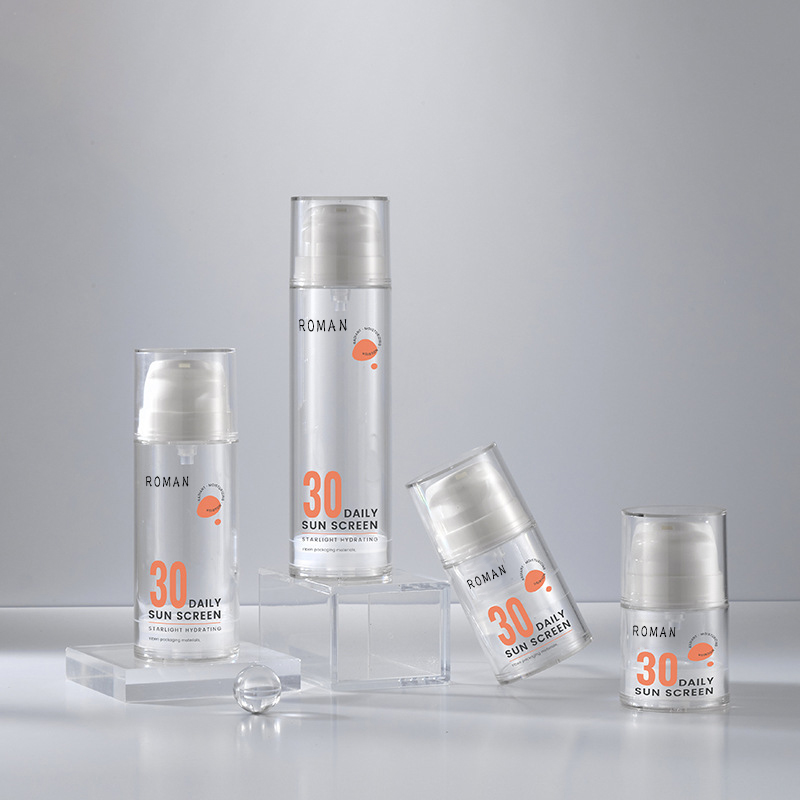 Transparent White Airless Pump Bottles for SkincareAvailable in 15-120 ml with OEM/ODM customization, this airless pump helps protect sensitive formulas from oxidation and supports controlled dosing for skincare packaging.View Product →
If you want to see how these design trade-offs play out commercially, the industry note on why skincare brands keep choosing airless bottle packaging covers the demand side of the same story.
Before approving tooling, ask any supplier for three things: actuation force in newtons, dose consistency across a 30-press sample, and results from a leak test after a drop from one metre. A pump that doses 0.25 ml on press one and 0.19 ml on press twenty will generate consumer complaints you cannot fix with copywriting.
Lotion Pump Bottles: The Workhorse for Emulsions and Cleansers
Roughly seven out of ten skincare bottles sold in volume are lotion pump bottles. They are cheap to mould, forgiving of formula changes, and familiar to consumers. The mechanism is simple: a dip tube reaches the bottom of the bottle, a spring-loaded piston draws liquid up, and a nozzle deposits it. Dose per stroke generally ranges from 0.5 ml for a facial cleanser to 2.0 ml for a heavy body lotion.
Most of the practical failures in this category come down to dip tube length and viscosity matching, not to the bottle itself.
Dip tube length and angle
The dip tube should stop 2 to 3 mm above the base of the bottle, and the tip is frequently cut at an angle so the last portion of product still reaches the inlet. A tube that is too long curls against the bottom and blocks; a tube that is too short leaves 15 ml of product stranded in a 300 ml bottle. This is a specification you can verify with a sample and a pair of scissors before mass production, and it costs nothing to fix at that stage.
Viscosity windows
A standard lotion pump handles liquids from roughly 1,000 to 15,000 cP comfortably. Above that range, the pump needs a wider orifice, a shorter suction path, or a different closure altogether. Thick body butters and cream cleansers are usually better served by a flip-lid squeeze bottle, a disc-top bottle, or a jar.
Neck finishes and pump choice
Common neck sizes in this family are 24/410, 24/415, 28/410 and 33/410. The first figure is the neck diameter in millimetres; the three digits that follow describe the thread profile and height, which is why a 24/410 and a 24/415 closure are not interchangeable even though both are "24". Lock-down pumps ship with the nozzle rotated closed, which avoids accidental actuation in transit. For formulas containing aggressive actives, ask whether a metal-free fluid path is available, since the pump spring normally sits inside the product stream.
Decorating options are broad: frosted PET, matte soft-touch, silk-screen print, hot stamping, or pressure-sensitive labels. Because these bottles are moulded in high volumes, they are the cheapest per unit to decorate, which is one reason large-format body care almost always lands here.
Foam Pump Bottles: Turning a Thin Liquid into a Mousse
A foam pump does not simply dispense liquid; it mixes that liquid with air at a ratio of roughly one part product to seven to twelve parts air, forcing the mixture through a mesh screen. The result is a dense, stable foam delivered without propellant gas. It is an elegant solution for cleansers and hand washes — and a reliable source of disappointment for brands that fill it with the wrong formula.
The hard constraint is viscosity. Foaming pumps need a water-thin liquid, typically below 100 cP, and the formula generally requires surfactant to stabilise the foam structure. Oil-heavy cleansers, thick gels and high-silicone formulas either produce a collapsing foam or no foam at all. If your chemists have developed a rich balm-to-milk cleanser, a foam pump is the wrong package regardless of how good it looks in a reference deck.
Dose per stroke is usually 0.4 to 1.2 ml, which means a 150 ml bottle delivers roughly 150 to 250 applications — a useful number when you are comparing cost per use against a competing format. Mesh pore size influences foam density, and two-piece mesh assemblies generally outperform single-mesh versions in consumer testing on foam structure retention.
Applications extend well beyond facial cleanser: hand soap, shaving foam, hair mousse, baby wash, eyelash shampoo for lash extension studios, and hotel amenity programmes. Bottle bodies are usually PET for clarity or PP for opaque colour, and popular add-ons include a soft silicone brush head for facial cleansing and a comb applicator for scalp treatments. As with lotion pumps, the closure and bottle should be sourced as a matched set where possible, because foam pumps are more sensitive to thread tolerance than simple caps.
Fine Mist Spray and Continuous Spray Bottles
Spray bottles split into two mechanisms that look identical from the outside. A fine mist sprayer uses a finger-actuated pump with an orifice typically between 0.1 and 0.2 mm, delivering around 0.1 to 0.15 ml per press. A continuous spray uses a spring-loaded or bag-on-valve chamber and releases a sustained mist for several seconds from a single press, which is why it dominates sunscreen and salon applications.
Fine mist bottles suit toners, setting sprays, hydrating mists, hair mist and disinfectant sprays. Capacity sweet spots are 50 ml for travel and sampling, 100 to 120 ml for facial toner, and 150 to 200 ml for body or hair use. The formula needs to be thin — ideally below 50 cP — and free of particulates that would clog the nozzle. Electrolyte-rich formulas are worth testing specifically for crystallisation at the nozzle after the water evaporates, a failure mode that only appears after a bottle has been sitting open on a shelf.
Gasket material matters more than most buyers expect. Alcohol-heavy formulas, fragrance oils and essential oils interact differently with NBR, EPDM, silicone and PE seals. A gasket that swells will leak; a gasket that hardens will stop sealing. Ask for the seal material in writing and run a four-week compatibility test at 40 degrees Celsius before committing to a production run.
Continuous spray formats handle thicker and oilier products, work at any angle including upside down, and avoid propellant entirely in bag-on-valve designs. They cost more per unit, but for sunscreen, tanning oil and hairdressing products the consumer experience usually justifies the premium.
Dropper Bottles and Serum Bottles: Precision Dosing and Visible Fill
Dropper bottles cover a narrow capacity range — mostly 5 to 50 ml, with 30 ml the industry default for facial serum and 15 ml common for eye serum and concentrated actives. Their appeal is functional and visual at once: the consumer can see how much product is left, and dosing is measured in drops rather than in pumps.
Standard neck finish is 18/415, with 18/400 variants appearing in some markets. Glass bodies dominate because glass is inert, does not absorb fragrance, and reads as premium. Soda-lime glass is the norm; amber or violet glass is used for light-sensitive oils, and frosted finishes hide minor scratches and fingerprints. The trade-offs are weight and breakage. A 30 ml glass bottle with a dropper can weigh 70 to 100 grams empty, against roughly 20 grams for a comparable PETG bottle, and that difference shows up directly in freight cost and damage claims.
Thick-wall PETG has become a credible alternative for brands shipping to distant markets. It delivers similar gloss, resists breakage in transit, and can be moulded with heavy walls that mimic the weight of glass — though not its thermal feel. For high-value formulas that are genuinely light-sensitive, glass with an amber or opaque coating still wins.
Two specification details derail dropper projects more than any others. The first is pipette length: a 1 ml graduated pipette must match the bottle height so the tip sits just above the base without touching it, and the bulb must clear the shoulder when the cap is screwed down. The second is bulb material. TPE bulbs are the common choice, but essential oil blends and solvent-rich formulas can degrade certain rubber compounds over time, causing the bulb to stick or split. Confirm compatibility, then confirm it again with a filled sample stored on its side for a month.
Disc-Cap, Flip-Lid and Squeeze Bottles
Not every skincare product needs a pump. Shampoo, shower gel, conditioner, toner and body wash are frequently packed in bottles with simple closures, and those closures are cheaper, lighter and less prone to failure than any mechanical dispenser.
Disc-cap bottles
A disc top cap opens when the disc is pressed and closes when it is released, which allows genuine one-hand dispensing. These bottles are commonly stored upside down, so the product sits at the closure and flows immediately. Standard neck is 24/410, capacities run 100 to 500 ml, and PET or HDPE bodies are typical. The inverted storage habit is also the main risk: a cap with weak spring tension will weep product onto a bathroom shelf, so check the closing force specification.
Flip-lid bottles
Flip-lid closures use a hinged lid over an orifice of 1 to 2 mm and suit both water-thin liquids and higher-viscosity gels. They are the lowest-cost closure in the category, need no priming, and cannot leak through a pump mechanism because there is no pump. For toners, shampoos and body washes in the 100 to 500 ml range, they remain the default commercial choice.
Squeeze bottles
PE and HDPE squeeze bottles in oval or round profiles give the consumer direct control over flow rate, which suits viscous cleansers and massage oils. The trade-off is that they are opaque and offer limited decoration options compared with PET. For premium positioning, a matte finish and a well-designed label usually do more than a change of material.
Syringe, Ampoule and Stick Formats: Small Volumes with Strong Signals
Away from the mainstream families sit several formats built for specific commercial moments. Syringe-shaped airless bottles, usually 5 to 30 ml, deliver eye cream, whitening gel or ampoule concentrate with a precision that a standard pump cannot match, and they carry a clinical or professional signal that works well in dermocosmetic positioning. Ampoule-shaped and rocket-shaped bottles serve a similar purpose for single-use or short-course treatments.
Twist-up sticks occupy 6 to 75 ml and hold deodorant, sunscreen stick, lip balm and solid body balm. These are genuine packaging engineering projects rather than simple containers: the wax hardness, the platform travel, and the fill temperature all have to be balanced, and the mechanism has to survive a 40 degrees Celsius shipping simulation without the product sliding out of the tube. Bottom-fill and top-fill versions exist, and the choice affects both the filling line and the unit cost.
These formats are rarely the highest-volume line in a brand's portfolio, but they are often the highest-margin. Their value comes from differentiation and from the specificity of the use case, not from unit economics.
Glass Skincare Bottles: Premium Perception and Its Real Costs
Glass carries a weight in the hand that no plastic replicates, and it is chemically inert, which matters for fragrance-heavy and pH-extreme formulas. The catalogue of glass skincare bottles covers lotion pump bottles, foam pump bottles, dropper bottles and perfume bottles, with finishes ranging from clear and frosted to coloured gradient, and closures from electroplated caps to natural wood.
The costs are real and worth planning for. Empty weight runs three to five times that of an equivalent plastic bottle, which increases freight, requires stronger cartons and dividers, and raises breakage exposure throughout the supply chain. Glass is also the wrong choice for formats where consumers squeeze the bottle, and for travel kits where weight is a decisive purchase factor.
One technical note worth knowing: strongly alkaline formulas can slowly attack soda-lime glass over long storage periods, and thick-walled glass is more prone to visible stress marks near the neck if the moulding is inconsistent. Both issues are manageable, but they are reasons to run a real-time stability test in the actual glass container rather than in a lab beaker. The practical rule is simple: use glass where the formula or the brand positioning genuinely needs it, and use plastic where the shipping economics dominate.
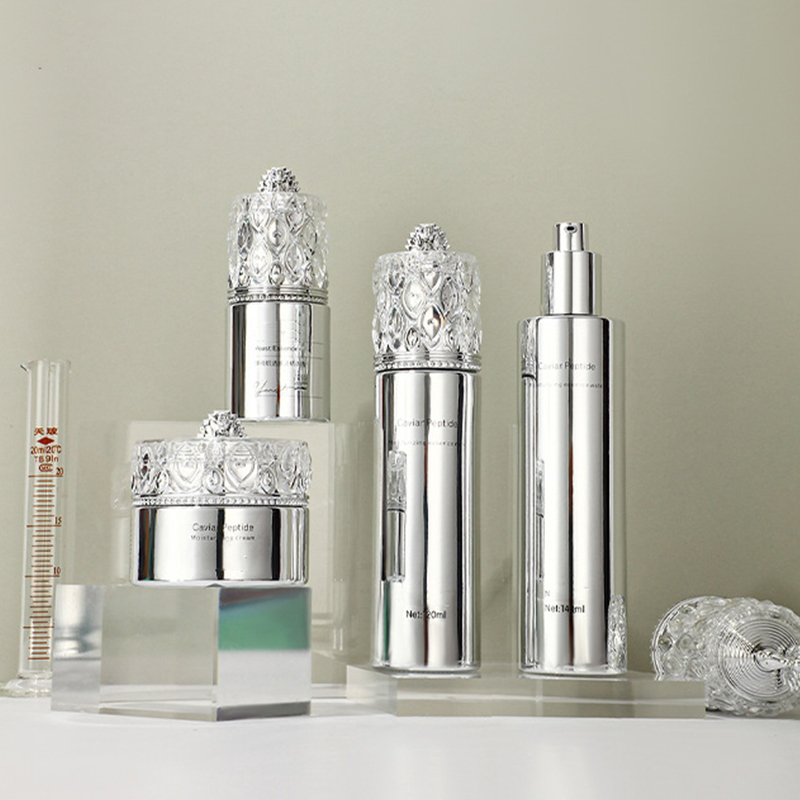 Frosted Glass Lotion Bottles for Skincare PackagingPremium glass cosmetic bottles with logo frosting customization, suited to lotion, face cream, and mask packaging where impermeability and premium shelf presence matter.View Product →
Material Selection: PET, PETG, PP, HDPE, PCR and Bio-Based Plastics
Material choice decides chemical compatibility, clarity, wall thickness, weight, recyclability and cost. It is the second decision after dispenser type, and it should be made with the formula list open, not from a colour swatch.
| Material | Clarity | Chemical resistance | Typical use | Watch-outs |
|---|---|---|---|---|
| PET | High, glass-like | Good for water-based; poor with terpenes | Lotion pumps, sprays, disc caps | Can craze with essential oils and strong solvents |
| PETG | High, heavy-wall | Better than PET | Thick-wall serum and essence bottles | Higher cost; not always available in recycled grades |
| PP | Opaque or clarified | Excellent | Airless bodies, jars, caps, foam bottles | Lower gloss; clarified grades cost more |
| HDPE / PE | Opaque | Excellent | Squeeze bottles, shampoo, body wash | Poor decoration surface; matte only |
| PS / SAN | Very high, rigid | Moderate | Airless outer shells, thick-wall jars | Can crack under impact; limited solvent tolerance |
| Glass | Highest | Inert | Serum, oil, perfume, premium lotion | Weight, breakage, freight cost |
| PCR (rPET / rPP) | Varies by grade | Similar to virgin | Sprays, lotion bottles, jars | Colour variation between batches; document content |
| Wheat straw filled | Opaque, speckled | Good | Shampoo, body wash, eco lines | Usually not compostable despite marketing claims |
| Bamboo composite | Opaque, natural | Moderate | Decorative lids and sleeves | Moisture treatment needed to prevent mould |
Two practical points save money here. First, a heavier wall almost always reads as more premium than a different material, and it is usually cheaper to achieve. Second, matching an existing mould beats designing a new one whenever the launch timeline is shorter than four months.
Neck Finish and Closure Compatibility: The Most Expensive Small Mistake
Neck finish is where otherwise well-run projects fail. A 24/410 pump and a 24/410 bottle sound compatible because they share a designation, but thread pitch, thread depth, start count and moulding tolerance all vary between manufacturers. A closure that fits one supplier's bottle may leak on another's.
Common neck finishes in skincare:
- 18/415 and 18/400 — dropper bottles, small serum and oil formats.
- 20/410 — slim mist sprays and small travel bottles.
- 24/410 — the workhorse for lotion pumps, disc caps and flip lids.
- 24/415 — taller thread profile, often used for heavier pumps and closures.
- 28/410 — large lotion and shampoo bottles.
- 33/410 — high-viscosity and professional salon formats.
The rule for buyers is straightforward: whenever bottle and closure come from different suppliers, order a fit sample before production and test it with the real filling line, not by hand. Torque is the second half of the same problem. Over-tightening a capping head cracks necks; under-tightening produces leaks in transit. A typical target for a 24/410 screw closure sits in the region of 15 to 25 inch-pounds, and the exact figure should come from a documented capping trial.
Liner selection matters too. An induction seal suits a liquid that must remain airtight until first use. A linerless cap reduces component cost but demands tighter moulding tolerances. For products with a preservative system that depends on low oxygen ingress, the closure is part of the preservation strategy, not an accessory.
Capacity Planning: How to Choose Sizes That Actually Sell
Capacity is a marketing decision and an engineering constraint at the same time. Marketing wants a number that reads well; engineering needs enough headspace for the pump, the piston or the foam to work.
Useful planning figures:
- Fill pumps and foamers to roughly 85 to 90 percent of nominal capacity. Foaming pumps need an air gap to function.
- A 50 ml airless bottle at 0.25 ml per stroke delivers about 180 applications.
- A 200 ml foam bottle at 0.8 ml per stroke delivers about 150 to 200 uses.
- A 150 ml fine mist at 0.12 ml per spray delivers well over 1,000 sprays.
- Nominal volume and printed weight rarely match, because cream at a density of 0.9 g per ml fills 50 ml but weighs about 45 g.
The most commercially useful pattern is family sizing: a 30 ml, 50 ml and 100 ml variant sharing one bottle profile, one closure and one decoration design. Tooling and artwork costs are amortised across the range, and shelf presence becomes consistent. Travel sizes at 30 to 50 ml also sit comfortably under the 100 ml cabin baggage rule in most markets, which remains a genuine purchase driver in travel retail.
Decoration and Surface Finishing: Where Perceived Value Is Built
Two bottles of identical geometry can sell at very different prices because of finish. The available processes include spray coating, UV coating, soft-touch matte, frosted etching, silk-screen printing, hot stamping, heat transfer and labelling with pressure-sensitive, shrink or in-mould films.
Soft-touch and matte finishes photograph well and feel expensive, but they show fingerprints and can scuff in transit; a scuffed bottle in a retail environment reads as a quality problem. Silk-screen printing is durable but limited in colour count per pass, and each additional colour adds setup cost and lead time. Electroplated caps deliver the strongest metallic effect but create recycling complications in many markets, so brands with sustainability commitments sometimes specify a sprayed metallic finish instead.
Colour matching deserves its own line in the project plan. Matching a Pantone reference to plastic involves the resin base colour, the masterbatch, the wall thickness and the lighting in which the product will be judged. Expect a small but real deviation between the approved master sample and production batches, and define an acceptable tolerance in writing before the mould is cut. Decoration typically adds 7 to 15 days to production lead time and often creates a separate minimum order quantity per colour, which catches buyers who planned only for the undecorated volume.
Sustainability: PCR Content, Mono-Material and Refillable Systems
Sustainability in skincare bottles has moved from a marketing theme to a specification item. Three approaches dominate.
Post-consumer recycled content. rPET and rPP are available at 30 percent, 50 percent and 100 percent recycled content, and they perform close to virgin resin in most skincare applications. Colour consistency between batches is the main practical difference, and any claim about recycled content needs supporting documentation from the resin supplier, because regulators in several markets now require substantiation.
Mono-material construction. A bottle, pump body and spring made entirely from PP can be processed in one recycling stream, whereas a conventional airless assembly with a metal spring typically cannot. Mono-material airless formats with TPE springs solve this, and the difference is invisible to the consumer.
Refill and replaceable systems. Refillable airless cartridges and replaceable inner cups reduce packaging weight per use by a large margin while preserving the original bottle as a durable object. They also create a repeat purchase mechanic, which is why the format has spread quickly.
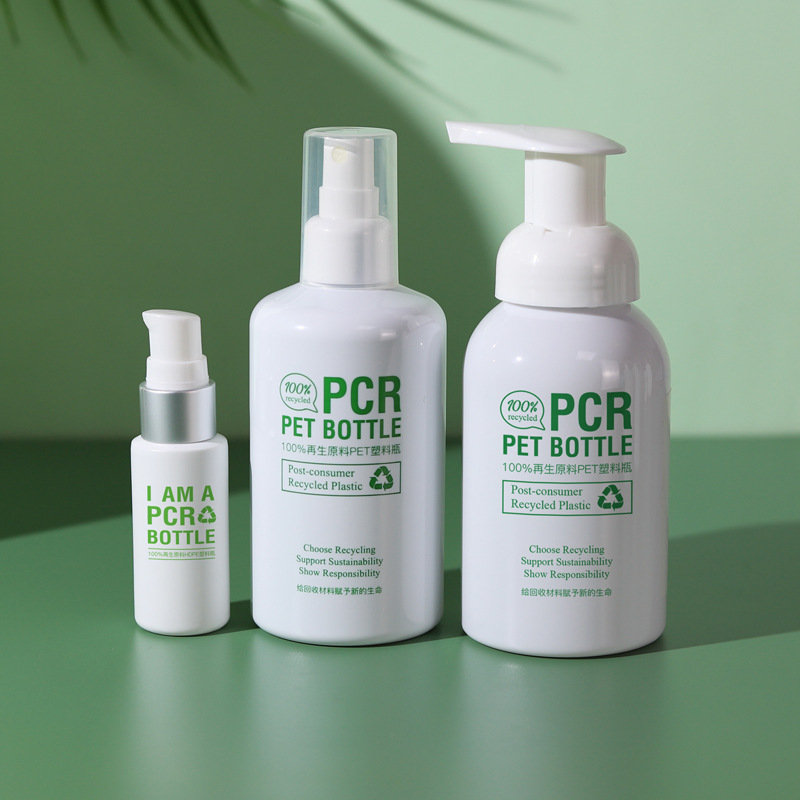 PCR PET Pump and Spray Bottles for CosmeticsAvailable from 200 ml to 500 ml, these PCR PET bottles use a pump head for controlled dosing in hair, body, face, and cleaning products.View Product →
Two claims need caution. Wheat straw and similar bio-filled plastics are usually conventional polymers with 10 to 30 percent agricultural filler; they are not compostable unless certified against a recognised standard. And "recyclable" depends on local collection infrastructure, so a widely accepted phrasing is that the pack is designed for recycling where facilities exist. Precision in wording protects the brand from regulatory challenges later.
A Practical Selection Checklist for Packaging Buyers
Working through this list in order prevents most of the rework that packaging projects generate:
- Record the formula's viscosity in cP, its pH, its alcohol or oil content and its oxygen sensitivity.
- Choose the dispenser family that matches that viscosity; do not choose it from a competitor's photograph.
- Confirm the dose per stroke and calculate the number of uses for each candidate capacity.
- Select the material for chemical compatibility first, appearance second.
- Fix the neck finish and confirm that bottle and closure are a matched pair.
- Verify nominal versus usable fill, including headspace for the pump or piston.
- Decide decoration, and add its lead time and colour-specific minimums to the plan.
- Check that required labelling and recycled-content claims can be substantiated.
- Order physical samples and fill them with your own formula, on your own line if possible.
- Run dose consistency, leak, drop, capping torque, print adhesion and four-week 40 degrees Celsius stability tests before releasing production.
Each step costs a few days. Skipping any of them typically costs a production run.
Common Specification Mistakes and How to Avoid Them
Some failures recur so regularly that they are worth naming directly.
- Filling a gel cleanser into a foam pump. The pump needs a thin, surfactant-containing liquid. No foam means no product experience.
- Using an airless bottle with a particulate formula. Coarse scrub beads block the valve. Keep particles below roughly 200 to 300 microns, or choose another format.
- Cutting the dip tube by guesswork. Too long and it curls against the base; too short and product is stranded. Specify the length in the purchase order.
- Ignoring solvent compatibility. Essential oils and solvent-heavy fragrances can craze PET and stress PS components over weeks, not days.
- Mixing closure suppliers without a fit test. Two 24/410 components from two factories are not guaranteed to seal together.
- Testing in a beaker instead of in the bottle. Stability results in glass beakers tell you nothing about interaction with a pump spring or a PE gasket.
- Underestimating decoration lead time. Printing and coating are separate production steps with separate queue times.
- Packing glass like plastic. Dividers and heavier cartons are not optional if you want a claim-free delivery.
- Filling an airless bottle to the printed volume. The piston needs travel space; overfilling causes leaks at the pump collar.
- Accepting verbal claims about recycled content. Ask for documentation at the quotation stage, not after the launch.
Sourcing Skincare Bottles: MOQ, Tooling and Lead Time
Once the specification is settled, the commercial questions are predictable: minimum order quantity, tooling cost, sampling time and production lead time.
Existing moulds remove tooling cost entirely and usually cut lead time to three to five weeks after artwork approval. A custom bottle requires a new injection mould, with cost driven by size, cavitation and complexity, and adds several weeks before the first sample. Minimum order quantities commonly start in the low thousands per bottle and per decoration colour, though stock moulds are more flexible than custom ones.
Suppliers with in-house decorating capacity compress the schedule considerably, because coating, printing and assembly happen under one roof instead of moving between three vendors. Shaoxing Roman Plastic Co., Ltd., for example, operates from a 13,000 square metre facility in Shangyu, Zhejiang, with more than 50 injection moulding machines and over 15 assembly and packing lines, producing plastic skincare bottles, glass bottles, cosmetic jars and beauty tools for OEM and ODM customers, with an annual export value in the region of four to five million US dollars and shipping access via Ningbo and Shanghai.
When requesting quotes, send the same specification sheet to every supplier: dispenser type, dose per stroke, neck finish, material, nominal capacity, decoration, and target annual volume. Quotes that arrive without those details are guesses, and the gap between a guess and a production order is where budgets disappear. You can review the full container range in the bottle and jar catalogue to compare moulds that already exist before deciding whether a custom design is worth the tooling.
Choosing a skincare bottle is a sequence, not a search. Start with the formula: viscosity, pH, oxygen sensitivity and the interaction between the two. Let that choose the dispenser. Let the dispenser choose the neck finish and the headspace. Let the material follow from chemical compatibility and shipping distance. Only then decide how the bottle should look, because decoration is the one part of the specification that can be redesigned at any point without invalidating the engineering underneath.
The brands that get this right tend to ask the boring questions early — dose per stroke, dip tube length, capping torque, residual product, recycled content documentation — and they ask them of the supplier before tooling, not of the customer service team after launch. Those questions cost nothing at the sampling stage and are extremely expensive later.