English
 Español
Which Bamboo Packaging Format Do You Actually Need?
If your formulation is a thick cream, balm, or solid product, a Bamboo Cosmetic Jar is the correct choice. If your product is a fluid lotion, serum, or body wash with standard viscosity, a Bamboo Lotion Pump Bottle is the right fit. If your formulation is oxidation-sensitive, air-reactive, or requires precise micro-dosing, a Bamboo Airless Pump Bottle is the only appropriate option. These three formats are not interchangeable. Using the wrong package for a given formulation accelerates product degradation, causes dispensing failures, and undermines the sustainability claims that bamboo packaging is meant to support.
The bamboo element in all three formats serves the same function: it replaces a portion of the plastic or metal outer structure with bamboo veneer, bamboo fiber composite, or solid moso bamboo. The inner functional components, including liners, pump mechanisms, and seals, still involve other materials. Understanding exactly where bamboo appears in each format, and where it does not, is essential before making a sourcing or purchasing decision.
What Is a Bamboo Cosmetic Jar and When Should You Use It
A Bamboo Cosmetic Jar is a wide-mouth container with a lid, where part or all of the outer shell is constructed from bamboo. The construction method falls into three categories that are important to distinguish when sourcing.
Three Construction Types of Bamboo Cosmetic Jar
- Bamboo veneer over plastic body: The most common commercial format. A standard polypropylene (PP) or ABS plastic jar body is wrapped or bonded with a thin bamboo veneer sheet. The bamboo accounts for approximately 15% to 30% of the total material by weight. The inner contact surface is entirely plastic and safe for direct product contact.
- Bamboo fiber composite body: The jar body is injection-molded from a blend of bamboo fiber powder and a bioplastic or PP resin binder. Bamboo content typically ranges from 30% to 60% by weight depending on the manufacturer. This format offers a more uniform appearance without visible wood grain seams.
- Solid moso bamboo with glass or PP liner: The outer jar is turned or machined from solid moso bamboo. A separate glass or PP inner liner holds the product and prevents direct contact between the formulation and the bamboo. This is the most premium and most expensive construction. It accounts for fewer than 10% of Bamboo Cosmetic Jar products in the mainstream market as of 2025.
Product Types Best Suited for a Bamboo Cosmetic Jar
Wide-mouth jar access is essential for thick formulations that cannot be dispensed through a narrow pump orifice. The following product types are correctly matched to a Bamboo Cosmetic Jar:
- Face creams and moisturizers with viscosity above 50,000 mPas
- Eye creams and under-eye balms in 5 ml to 30 ml sizes
- Body butters and whipped shea formulations
- Solid perfume, solid face mask bars, and wax-based cleansing balms
- Hair pomades, edge controls, and styling waxes
- Powder products including loose mineral foundations and pigmented powders with a sifter insert
Standard Sizes and Capacity Range
Bamboo Cosmetic Jars are commercially available in a wide range of capacities. The most commonly stocked sizes in the cosmetic packaging supply chain are 5 ml, 10 ml, 15 ml, 30 ml, 50 ml, 100 ml, 150 ml, and 200 ml. Sizes below 15 ml are typically used for eye cream and travel sizes. Sizes of 50 ml and above are standard for face and body moisturizers. Custom capacities outside these standard sizes require minimum order quantities (MOQs) that are often 3,000 to 10,000 units per size depending on the manufacturer.
Key Considerations Before Buying a Bamboo Cosmetic Jar
- Moisture compatibility: Raw bamboo is hygroscopic and will warp, crack, or develop mold if exposed to high-humidity environments without adequate sealing. Ask suppliers whether the outer bamboo surface is sealed with a food-safe lacquer, natural beeswax, or polyurethane coating. Unsealed bamboo jars are not appropriate for bathroom shelf use in humid climates.
- Liner material and compatibility: Confirm whether the inner liner material is compatible with your formulation. PP liners are suitable for most water-based and oil-based creams. If your formulation contains strong solvents, high concentrations of essential oils above 3%, or aggressive active ingredients such as benzoyl peroxide above 5%, request compatibility testing documentation.
- Lid seal tightness: A Bamboo Cosmetic Jar lid that relies on a bamboo-to-bamboo friction fit will loosen over time as the bamboo expands and contracts with temperature. Always look for jars with a separate inner PP or silicone seal ring inside the lid to maintain airtightness independently of the bamboo outer fit.
- Drop resistance: Solid moso bamboo jars are heavy and brittle when dropped onto hard floors. Bamboo veneer over PP is more impact-resistant. For retail environments where consumer handling is frequent, veneer over PP or fiber composite is more practical than solid bamboo.
What Is a Bamboo Lotion Pump Bottle and How Does It Work
A Bamboo Lotion Pump Bottle combines a dispensing pump mechanism with a bottle body that incorporates bamboo in its outer construction. The pump mechanism itself is almost always made from PP plastic, stainless steel spring wire, and a glass or steel ball check valve. The bamboo component is the outer bottle sleeve, the pump collar, or both. Genuine all-bamboo pump mechanisms do not yet exist commercially at scale due to the precision tolerances required for pump components.
How the Lotion Pump Mechanism Functions
The standard lotion pump operates on a positive displacement principle. When the actuator (the pump head) is pressed down, it compresses a spring inside a cylinder. This creates positive pressure that closes the inlet check valve and opens the outlet valve, forcing product through the dip tube and out of the nozzle. When the actuator is released, the spring pushes it back up, creating negative pressure that opens the inlet valve and draws product from the bottle into the cylinder, ready for the next press.
A standard 0.5 ml dosage pump requires approximately 2 to 3 newtons of actuator force and dispenses between 0.4 ml and 0.6 ml per stroke depending on formulation viscosity. A 1.0 ml dosage pump for thicker lotions requires 3 to 5 newtons of actuator force. These specifications matter when choosing a pump for formulations at the viscosity boundary between fluid and thick.
Viscosity Range for Bamboo Lotion Pump Bottle Use
| Formulation Type | Approx. Viscosity (mPas) | Pump Dosage Recommendation | Suitable for Lotion Pump? |
|---|---|---|---|
| Water, toner, mist | 1 to 50 | 0.1 ml to 0.2 ml spray | No (use fine mist sprayer) |
| Serum, light fluid lotion | 500 to 3,000 | 0.5 ml per stroke | Yes |
| Body lotion, hand lotion | 3,000 to 20,000 | 1.0 ml per stroke | Yes |
| Thick face cream | 20,000 to 50,000 | 1.5 ml to 2.0 ml per stroke | Marginal (test required) |
| Balm, butter, wax | Above 50,000 | Not applicable | No (use jar) |
Bamboo Coverage in Lotion Pump Bottle Design
Bamboo Lotion Pump Bottles are produced in several structural configurations. The most common in the 2024 to 2026 market are:
- Bamboo sleeve over HDPE or PET bottle: The primary bottle is standard high-density polyethylene or PET. A fitted bamboo veneer sleeve is bonded around the bottle exterior. The sleeve can be natural bamboo color, carbonized dark brown, or dyed. This is the most cost-effective bamboo lotion pump format and is available in standard 100 ml, 150 ml, 200 ml, 250 ml, and 500 ml sizes.
- Bamboo composite bottle body with PP inner: The bottle wall itself is made from a bamboo fiber and PP blend. The bamboo composite provides structural rigidity and aesthetics. Inner surface contact with product is still PP. Available in 100 ml to 300 ml sizes from specialist packaging manufacturers.
- Bamboo pump collar and actuator only: The bottle is standard PP or HDPE, but the pump collar ring and actuator (the part the consumer presses) are made from bamboo or bamboo composite. This is the lowest-cost entry point to bamboo branding and is popular for mass-market natural and organic lines.
Dip Tube Length and Product Extraction Efficiency
One frequently overlooked specification for a Bamboo Lotion Pump Bottle is the dip tube length. The dip tube extends from the pump mechanism down to near the bottom of the bottle, drawing product upward into the pump chamber. If the dip tube is too short by even 5 mm to 8 mm, the consumer will be unable to dispense the last 15% to 20% of product in the bottle, effectively wasting that volume. Always confirm that the supplier's dip tube length is matched within 3 mm of the interior bottle height for the specific capacity you order.
What Is a Bamboo Airless Pump Bottle and Why It Is Different
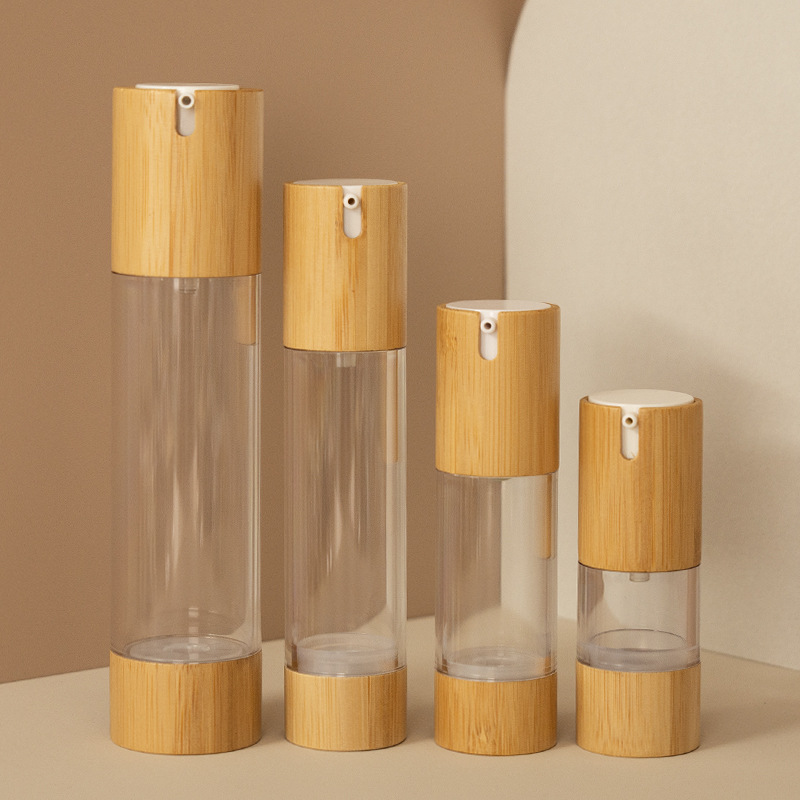
A Bamboo Airless Pump Bottle is fundamentally different from both the jar and the standard lotion pump. The defining feature is that product inside the bottle is never exposed to ambient air during use. Instead of drawing product up through a dip tube, the airless mechanism uses a rising piston inside the bottle. Each pump stroke moves the piston upward, pushing the product through the pump chamber without creating any air intake back into the bottle.
The Airless Pump Mechanism Explained
Inside a Bamboo Airless Pump Bottle, the bottle chamber is divided into two zones by a movable piston disk. Product sits above the piston. The space below the piston is vented to outside air through a small hole at the base of the bottle. When the pump actuator is pressed, a one-way valve opens and product is pushed out. When the actuator is released, the atmospheric pressure differential between the vented base and the sealed product chamber causes the piston to move upward by a precise increment, refilling the pump chamber with product from below without any air entering from above.
A standard 30 ml airless pump bottle has a piston stroke of approximately 0.3 mm per pump activation, and delivers between 0.15 ml and 0.5 ml per stroke depending on the pump design. Most cosmetic airless pumps are engineered for between 100 and 300 total actuations per fill, matching the intended use-up period of the product.
Why Oxidation-Sensitive Formulations Require an Airless System
The following active ingredient categories degrade significantly faster when exposed to air after the packaging is first opened. These are the formulations for which a Bamboo Airless Pump Bottle is not just preferable but necessary from a product stability standpoint:
- Vitamin C (L-ascorbic acid) above 10% concentration: L-ascorbic acid oxidizes rapidly in the presence of oxygen and light, turning yellow or orange and losing potency. Studies published in the International Journal of Cosmetic Science show that a 15% L-ascorbic acid serum stored in a standard open-mouth jar loses more than 50% of its active concentration within 3 months at room temperature.
- Retinol and retinaldehyde: Both compounds are highly susceptible to oxidative degradation. Even brief repeated air exposure through a standard jar or lotion pump accelerates the conversion of retinol to inactive retinoid byproducts.
- Niacinamide serums in sensitive formulations: At concentrations above 10%, niacinamide can degrade and form trace nicotinic acid (niacin) when repeatedly exposed to air and temperature fluctuation. This does not affect all niacinamide products but is a risk in formulations without robust preservation systems.
- Peptide serums and growth factor formulations: Peptide chain stability is sensitive to oxidation. Repeated air exposure also introduces microbial contamination risk in products with minimal preservative systems, such as those marketed as preservative-free.
- Bakuchiol, fermented actives, and probiotic-based serums: These newer generation actives are structurally sensitive and benefit from the controlled dispensing environment of an airless system.
Bamboo Integration in Airless Pump Bottle Formats
Bamboo Airless Pump Bottles are available in fewer construction variants than jars or standard pumps because the airless mechanism requires tighter dimensional tolerances. The commercially available formats are:
- Bamboo veneer wrap over PP airless bottle: The most widely available format. The functional airless bottle is standard PP construction. The bamboo veneer is bonded around the exterior. Available in 15 ml, 30 ml, 50 ml, and 80 ml sizes from most major cosmetic packaging suppliers.
- Bamboo composite collar, cap, and actuator with clear PP bottle body: Keeps the bottle body transparent so consumers can see product level while adding bamboo to the visible hardware components. Popular in prestige skincare and natural beauty brand positioning.
- Full bamboo composite shell airless system: The entire outer shell including body and cap is bamboo composite, with a separate inner PP airless mechanism. This is the most premium format, with MOQs typically starting at 5,000 units and unit costs ranging from USD 3.50 to USD 8.00 per piece at production volume.
Product Extraction Rate and Waste in Airless Bottles
A well-designed airless pump system achieves a product extraction rate of 95% to 98% of total fill volume. This is significantly higher than the 80% to 88% extraction typically achieved by standard lotion pumps with dip tubes, where the remaining product is inaccessible once the product level falls below the dip tube inlet. For premium serums priced at USD 60 or above per 30 ml, this 10% to 15% extraction efficiency difference represents a meaningful financial value to the consumer.
Side by Side Comparison of All Three Bamboo Packaging Formats
The table below condenses the most important decision variables into a single reference. Use this when briefing a packaging supplier, specifying formulation requirements to a contract manufacturer, or choosing between formats for a new product launch.
| Feature | Bamboo Cosmetic Jar | Bamboo Lotion Pump Bottle | Bamboo Airless Pump Bottle |
|---|---|---|---|
| Best formulation type | Thick creams, balms, solids | Fluid lotions, body wash, medium serums | Oxidation-sensitive serums, retinol, vitamin C |
| Air contact with product | Full air contact on each open | Partial air contact via dip tube | Zero air contact during use |
| Typical capacity range | 5 ml to 200 ml | 100 ml to 500 ml | 15 ml to 80 ml |
| Product extraction rate | 95% to 99% (scoop access) | 80% to 88% | 95% to 98% |
| Typical unit cost (MOQ 3,000) | USD 0.80 to USD 3.50 | USD 1.20 to USD 4.00 | USD 2.50 to USD 8.00 |
| Hygiene suitability | Lower (finger dipping) | Good (no direct contact) | Best (closed system) |
| Refillability | Easy (open top) | Moderate (pump removal needed) | Difficult (sealed piston system) |
| Recyclability | Moderate (disassembly needed) | Moderate (pump separation needed) | Lower (complex multi-material) |
The Real Environmental Profile of Bamboo Packaging
Bamboo cosmetic packaging is marketed extensively on its sustainability credentials. The environmental claims deserve careful scrutiny because the actual lifecycle picture is more nuanced than most marketing materials convey. The sustainability benefit of bamboo packaging is real but conditional: it depends on how the bamboo is processed, what other materials are combined with it, and how the consumer disposes of the finished package.
What the Data Actually Says About Bamboo as a Raw Material
Moso bamboo (Phyllostachys edulis), the species used in virtually all cosmetic bamboo packaging, is genuinely one of the most rapidly renewable plant materials on earth. It reaches harvestable maturity in 3 to 5 years compared to 25 to 60 years for hardwood trees. Moso bamboo sequesters approximately 5.1 tonnes of CO2 per hectare per year according to research published by the International Bamboo and Rattan Organization (INBAR) in 2022. A bamboo plantation of 1 hectare can produce approximately 30 to 40 tonnes of raw bamboo culms annually without replanting, because bamboo regenerates from its root system after harvest.
However, the processing of raw bamboo culms into cosmetic packaging components is energy-intensive. Bamboo veneer production involves soaking, pressing, drying, and bonding processes. Bamboo fiber powder for composite molding requires carbonization or chemical pulping, steam explosion, or enzymatic treatment. A lifecycle assessment published in the Journal of Cleaner Production in 2021 found that bamboo composite packaging produced in China for export to European markets had a total carbon footprint of approximately 1.8 kg CO2 equivalent per kilogram of finished product, compared to 2.3 kg CO2e for standard PP plastic packaging of equivalent weight. The margin is real, roughly 22% lower, but not transformative on its own.
The Multi-Material Challenge for End of Life
All three formats (Bamboo Cosmetic Jar, Bamboo Lotion Pump Bottle, and Bamboo Airless Pump Bottle) involve multiple materials that must be separated before either component can enter a recycling or composting stream. The practical recycling pathway for most consumers is:
- Remove the pump mechanism (PP, stainless steel spring, glass or PE ball) and place PP components in plastic recycling if the local facility accepts PP (recycling symbol 5).
- The bamboo outer sleeve or body can be composted in a hot compost system or industrial composting facility if it contains no synthetic adhesive. If bonded with epoxy or polyurethane, it is not compostable and should go to general waste.
- The inner PP liner of a Bamboo Cosmetic Jar, once separated from the bamboo, is recyclable in most municipal systems.
The practical reality is that fewer than 30% of consumers will properly disassemble multi-material bamboo cosmetic packaging before disposal, according to a 2023 consumer behavior survey by Euromonitor International on sustainable beauty packaging. This means the actual end-of-life benefit is significantly lower than the theoretical recyclability rate. Brands serious about sustainability should pair bamboo packaging with a take-back program or clearly illustrated disassembly instructions on the label.
Bamboo Certification Standards Brands Should Request
- FSC (Forest Stewardship Council) certification for bamboo: Confirms the bamboo was harvested from a responsibly managed forest. FSC certification for bamboo is available and is increasingly required by European retailers for natural packaging claims.
- OEKO-TEX Standard 100: Relevant for bamboo fiber composite materials, confirming the finished material has been tested for harmful substances including formaldehyde (which is used in some bamboo processing adhesives) and heavy metal residues.
- ISO 18606 (Packaging and the environment: organic recycling): Relevant if making compostability claims for the bamboo component. Without this certification, compostability claims for bamboo packaging are legally questionable under EU Directive 2005/29/EC on unfair commercial practices and the UK Green Claims Code.
How to Source Bamboo Cosmetic Jar, Bamboo Lotion Pump Bottle, and Bamboo Airless Pump Bottle
Sourcing quality bamboo cosmetic packaging requires navigating a supply chain that is concentrated primarily in Zhejiang, Guangdong, and Fujian provinces of China, with a smaller manufacturing base in Vietnam, Indonesia, and India. Approximately 75% to 80% of globally traded bamboo cosmetic packaging is manufactured in China as of 2025. This concentration creates both efficiency advantages (established supply chains, broad format availability) and risks (quality variability, long lead times, tariff exposure).
What to Specify in a Request for Quotation
When approaching a bamboo packaging supplier for the first time, provide the following specifications to get a meaningful and comparable quotation:
- Package type: Bamboo Cosmetic Jar, Bamboo Lotion Pump Bottle, or Bamboo Airless Pump Bottle
- Capacity in milliliters and the target fill weight in grams
- Construction type: bamboo veneer over PP, bamboo composite body, or solid bamboo with liner
- Bamboo surface finish: natural raw, lacquered, carbonized, engraved logo, or printed
- Pump dosage volume (for pump formats): 0.5 ml, 1.0 ml, or other
- Inner liner or bottle material: PP, HDPE, PET, or glass
- Required certifications: FSC, OEKO-TEX, ISO 18606, REACH compliance
- MOQ required and target landed unit cost
- Required lead time for samples and for production
- Compatibility requirement: formulation type, pH range, and any key actives above standard concentration
Typical Lead Times and MOQs by Format
| Format | Standard MOQ | Sample Lead Time | Production Lead Time | Custom Color or Logo MOQ |
|---|---|---|---|---|
| Bamboo Cosmetic Jar (standard size) | 500 to 1,000 units | 7 to 15 days | 30 to 45 days | 3,000 to 5,000 units |
| Bamboo Cosmetic Jar (custom size) | 3,000 to 10,000 units | 20 to 30 days | 60 to 90 days | As above (custom mold required) |
| Bamboo Lotion Pump Bottle (standard size) | 500 to 2,000 units | 10 to 15 days | 35 to 50 days | 3,000 to 5,000 units |
| Bamboo Airless Pump Bottle (standard size) | 1,000 to 3,000 units | 15 to 25 days | 45 to 60 days | 5,000 to 10,000 units |
Quality Control Checkpoints Before Accepting a Production Run
- Bamboo surface quality: Check for cracks, open grain lines, adhesive bleed-through, and uneven color distribution across the batch. Natural bamboo variation is expected, but splits or cracks exceeding 10 mm in length are quality failures.
- Pump priming test: For both Bamboo Lotion Pump Bottle and Bamboo Airless Pump Bottle, each pump should prime (begin dispensing product consistently) within 5 to 8 strokes of first use. A pump that requires more than 10 strokes to prime is likely to generate consumer complaints.
- Leak and pressure test: Fill 10% of a production sample batch with water. Store inverted for 48 hours. Any seepage around the pump neck, lid seal, or bottle base indicates a seal failure that will cause product leakage in transit or on shelf.
- Airless piston engagement: For Bamboo Airless Pump Bottle units, confirm the piston moves freely upward without sticking. A stuck piston is the most common functional failure in low-quality airless bottles and typically results from insufficient clearance between the piston disk and the inner bottle wall.
- Drop test: Drop 5 units from a height of 1 meter onto a hard concrete surface from each of three orientations: base down, side, and pump down. No cracks in the bamboo outer and no pump disengagement should occur.
Formulation Compatibility Testing for Bamboo Packaging
Even when the inner product contact surface of a bamboo package is stated to be PP or HDPE, compatibility testing is still a required step before product launch. The most common compatibility failures occur not between the formulation and the plastic itself, but between the formulation and the adhesive, lacquer, or colorant applied to the bamboo exterior that may have minor contact with the product fill zone at the neck or lid interface.
Standard Compatibility Test Protocol
A standard compatibility test for cosmetic packaging involves filling the package with the actual formulation, sealing it, and storing it under controlled conditions. Industry standard test conditions under ASTM D4169 and ICH Q1A (R2) for cosmetic products are:
- Accelerated stability test: 40 degrees Celsius and 75% relative humidity for 3 months. This is equivalent to approximately 12 months of ambient room temperature storage.
- Real-time stability test: 25 degrees Celsius and 60% relative humidity for 12 to 24 months.
- Freeze-thaw cycling: Three complete cycles of freezing to negative 10 degrees Celsius and thawing to 40 degrees Celsius. Evaluates dimensional stability of the bamboo outer shell under temperature stress.
At the end of the test period, evaluate the formulation for changes in pH, color, odor, viscosity, active ingredient concentration (for active serums), and microbial count. Evaluate the package for bamboo warping, cracking, delamination of veneer, degradation of the pump mechanism, or discoloration of the inner liner.
Formulations That Require Extended or Special Compatibility Testing
| Formulation Type | Key Compatibility Risk | Recommended Package Liner | Special Requirement |
|---|---|---|---|
| Vitamin C serum (above 15% L-ascorbic acid) | pH below 3.5 may attack adhesive in bamboo veneer bond | Glass inner or thick PP with sealed neck | Airless bottle only, nitrogen purge recommended |
| AHA exfoliant (above 10% glycolic acid) | Acid may degrade PP inner over 18 months | HDPE or glass liner | 18-month accelerated stability test required |
| Essential oil concentrate (above 5%) | Terpenes can dissolve bamboo lacquer and soften PP | Glass liner only | Avoid bamboo veneer adhesive contact |
| Benzoyl peroxide (5% and above) | Strong oxidizer, attacks most plastics and adhesives | Glass or HDPE liner only | Not recommended in bamboo veneer format |
Consumer Care and Maintenance of Bamboo Cosmetic Packaging
Consumer-facing bamboo cosmetic packaging requires more care than standard all-plastic packaging. Brands should include brief care instructions on the outer carton or insert to prevent premature degradation of the bamboo outer and maintain a positive consumer experience.
Humidity and Water Exposure
The most common consumer complaint about bamboo cosmetic packaging is cracking, warping, or darkening of the bamboo outer shell. This is almost always caused by prolonged exposure to direct water contact or persistent high humidity above 85% RH without drying periods. Bamboo veneer and composite that is sealed with quality lacquer can tolerate normal bathroom humidity (50% to 70% RH) indefinitely. However, placing a Bamboo Cosmetic Jar or pump bottle directly in a shower or leaving it in standing water will damage even well-sealed bamboo within 2 to 4 weeks.
Instructions for consumers should include: keep the package out of direct water spray, wipe dry after any water contact, and store in a cool dry location away from direct sunlight when not in use.
Cleaning and Refilling
Bamboo Cosmetic Jars are the format most likely to be refilled or repurposed by environmentally conscious consumers. The correct cleaning protocol is:
- Remove all remaining product with a spatula. Do not rinse with water until all product residue is removed.
- Wipe the inner liner with a clean dry cloth dampened with isopropyl alcohol at 70% concentration. Allow to air dry completely.
- Wipe the bamboo outer dry. Do not submerge in water.
- If refilling with the same formulation, no further treatment is needed. If switching formulations, request a compatibility confirmation for the new product before filling.
Pump Maintenance for Long-Term Use
Standard lotion pumps in a Bamboo Lotion Pump Bottle may become sluggish or clogged if the product dries inside the pump chamber between uses. Products with high wax, stearic acid, or cetyl alcohol content above 5% are most prone to pump clogging when the product cools between uses. To clear a clogged pump, actuate it several times with the dip tube submerged in warm (not hot) water, then dry fully before reattaching to the bottle. For airless pump bottles, never attempt to disassemble the mechanism to clean it; a clogged airless pump that cannot be cleared by actuating with warm water should be reported to the manufacturer as a potential quality failure.
Branding and Customization Options for All Three Formats
Bamboo surfaces offer distinctive customization opportunities that are not available on standard plastic packaging. The natural texture and color range of bamboo, from pale yellow to deep carbonized brown, creates a premium visual identity without any surface printing. Brands that use bamboo packaging without any printed or engraved logo consistently report higher perceived value scores in consumer focus groups compared to equivalent product in standard white PP packaging, with perceived value increases of 18% to 35% in studies conducted by packaging design agencies in 2022 and 2023.
Customization Methods Available for Bamboo Packaging
- Laser engraving: The most premium and durable customization method. A laser removes the surface layer of the bamboo to reveal a darker or lighter contrasting mark. No inks or dyes are used. Laser engraving is permanent and does not fade with use. Setup cost is typically USD 150 to USD 300 per design, with no per-unit cost premium above approximately 1,000 units.
- Hot stamping (foil blocking): A heated die presses a metallic or matte foil onto the bamboo surface. Gold, silver, rose gold, and matte black foils are standard options. Hot stamping on bamboo requires a lacquered or smooth surface for best adhesion. MOQ for hot stamping is typically 1,000 units.
- Screen printing: Ink is applied directly to the bamboo or bamboo composite surface through a screen. Suitable for multi-color designs. Durability is lower than laser engraving on raw bamboo but comparable to screen printing on PP when applied to lacquered bamboo surfaces.
- Carbonization pattern: Selected areas of the bamboo surface are heat-treated to create dark geometric or floral patterns in the bamboo grain. This is achieved during manufacturing and requires minimum 5,000-unit custom orders but creates a completely unique visual texture with no ink or foil.
- Custom collar and cap color: The PP collar ring, pump actuator, and lid can be matched to a Pantone color for brand consistency. Custom color tooling typically requires 3,000 to 5,000-unit MOQs and a tooling fee of USD 500 to USD 1,500.
Frequently Asked Questions
1. Is bamboo cosmetic packaging genuinely more sustainable than plastic packaging?
The honest answer is: partially and conditionally. Bamboo as a raw material is significantly more renewable than petroleum-derived plastic, and bamboo plantations sequester meaningful amounts of CO2. However, because all three bamboo packaging formats involve additional plastic components for functionality (liners, pumps, pistons), the total sustainability benefit depends heavily on whether the consumer properly disassembles and sorts the package at end of life. A bamboo jar that ends up in landfill intact is no more beneficial than a standard plastic jar. The sustainability benefit is maximized when brands use FSC-certified bamboo, minimize adhesive and coating chemicals, and provide consumer disassembly instructions with a take-back or refill program.
2. Can a Bamboo Airless Pump Bottle be refilled after the product runs out?
Most standard Bamboo Airless Pump Bottle formats are not designed for consumer refill. The piston-based mechanism seals the bottle interior in a way that makes bottom-filling or top-filling impractical without specialized equipment. Some premium brands offer a refillable airless format where the inner PP airless cartridge is replaceable while the bamboo outer shell is retained, but this requires a purpose-designed refill system that must be specified at the sourcing stage. Standard airless bottles encountered in retail are single-use fill formats.
3. What is the minimum order quantity for a small cosmetic brand starting out?
For standard-size Bamboo Cosmetic Jars with no custom logo, MOQs from major Chinese suppliers start at 500 units and some wholesale platforms offer mixed-size packs of 100 to 200 units at a higher per-unit cost. For Bamboo Lotion Pump Bottles, standard sizes can be ordered in quantities of 500 to 1,000 from stock. Bamboo Airless Pump Bottles have the highest entry MOQ, typically 1,000 to 3,000 units for standard sizes, due to the more complex mechanism assembly. For custom logos, engravings, or non-standard colors, all three formats require MOQs of 3,000 to 5,000 units minimum from most suppliers.
4. How do I stop a Bamboo Cosmetic Jar from developing mold on the bamboo surface?
Mold on bamboo packaging is caused by moisture trapped between the bamboo surface and the surrounding environment, combined with the natural organic composition of bamboo that provides a nutrient base for mold spores. To prevent this: ensure the jar is stored in a ventilated area between uses, wipe the bamboo surface dry if it becomes wet, and confirm with your supplier that the bamboo surface is sealed with an antimicrobial lacquer or a natural wax coat. For humid climate markets such as Southeast Asia, Japan, or coastal regions, always specify a sealed and wax-treated bamboo surface when ordering.
5. Can I fill a Bamboo Lotion Pump Bottle with an oil-based serum or facial oil?
Yes, with caveats. Light facial oils with viscosities below approximately 500 mPas (comparable to thin liquid oil) can be dispensed through a fine-mist spray or a low-viscosity lotion pump. However, standard lotion pump dosing of 0.5 ml to 1.0 ml per stroke will overdispense most facial oils, and the ball check valve inside the pump may be degraded over time by high concentrations of certain terpene-rich carrier oils such as rosehip or sea buckthorn. Confirm with the supplier that the pump ball and spring materials are compatible with the specific oil formulation before committing to a production fill.
6. What pump dosage per stroke should I specify for a face serum in a Bamboo Airless Pump Bottle?
For facial serums intended for full face application, a dosage of 0.3 ml to 0.5 ml per stroke is the industry standard. This matches the typical consumer application amount of 2 to 3 drops for a serum. At 0.3 ml per stroke and a 30 ml fill volume, the bottle delivers approximately 100 activations, representing a 3-month supply at once-daily use. Specifying a higher dosage of 1.0 ml per stroke is appropriate for body serums or multi-step layering products where larger doses are expected.
7. How should I communicate the bamboo content percentage to consumers without making misleading claims?
The most defensible language is to specify what part of the package is bamboo and what the bamboo content is by weight or by component. For example: "outer sleeve made from FSC-certified moso bamboo" or "bamboo fiber composite body contains 40% bamboo by weight." Avoid blanket statements such as "100% natural packaging" or "fully biodegradable" unless all components including pump mechanism and liner are certified compostable, because these claims are likely to trigger scrutiny under the EU Green Claims Directive (proposed 2023) and the UK Green Claims Code.
8. Is there a risk of the bamboo outer cracking during cold-chain shipping in winter?
Yes. Bamboo is hygroscopic and responds to rapid humidity and temperature changes. Shipping bamboo packaging through cold-chain logistics (below 5 degrees Celsius) followed by rapid warming at the destination can cause condensation inside the package, which is absorbed by the bamboo and then released rapidly as the package warms, creating internal stress that causes cracking or delamination of veneer. To mitigate this: specify a high-quality waterproof lacquer seal on all bamboo surfaces, pack units individually in polyethylene foam sleeves for cold-chain shipments, and allow packages to acclimate at destination temperature for 24 hours before opening cartons.
9. What is the typical shelf life or service life of a Bamboo Lotion Pump Bottle before the pump mechanism fails?
A quality lotion pump in a Bamboo Lotion Pump Bottle is typically tested and rated for a minimum of 30,000 actuations without failure. At a usage rate of 2 actuations per day, this represents over 40 years of mechanical life, meaning the pump mechanism will outlast the product fill many times over under normal use. Pump failures in commercial products are almost always caused by formulation incompatibility (product clogging or dissolving the valve components), incorrect priming by the consumer, or manufacturing defects, rather than mechanical wear under normal use cycles.
10. Can bamboo packaging be used for color cosmetics such as foundation or blush?
Yes. Bamboo Cosmetic Jars are an excellent format for loose powder foundations, mineral blushes, and pigmented face powders when fitted with a sifter insert and a secondary lid. Bamboo veneer over PP construction is the preferred format for color cosmetics because it provides a stable, impact-resistant structure that protects the powder from vibration and impact during shipping. Confirm that the inner PP liner and sifter insert material are compatible with the specific pigment load and any mica or titanium dioxide concentrations in the formula. For liquid foundation, a Bamboo Airless Pump Bottle in 30 ml format with a 0.5 ml dosage pump is the correct packaging choice due to the pigment settling risk in standard dip-tube pump bottles.