English
 Español
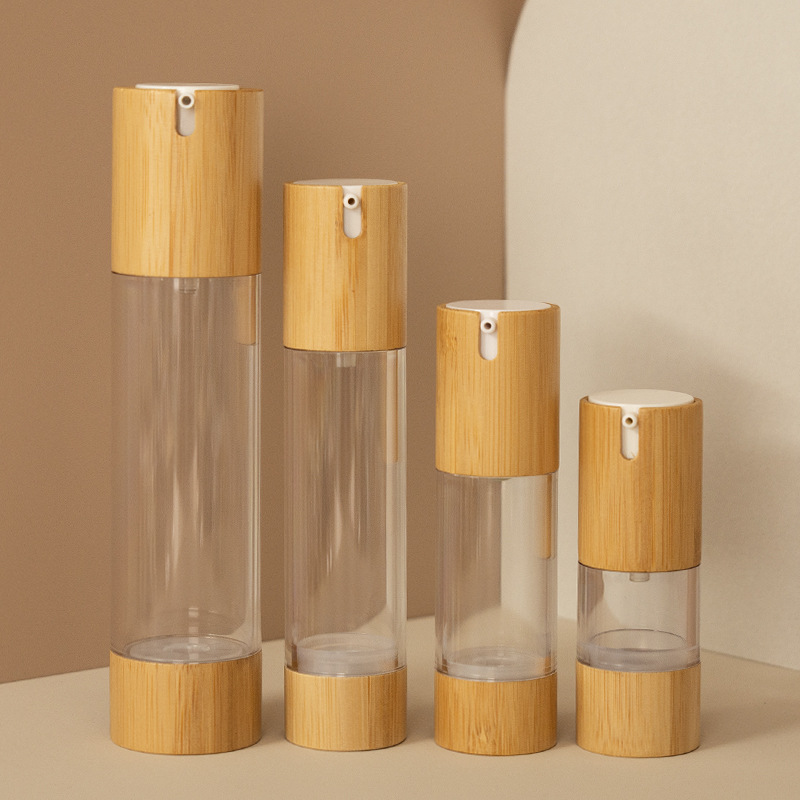
In today's cosmetic market, packaging is no longer just a container for products; it is an extension of a brand's values. With the escalation of global plastic bans and the consumer craze for "Clean Beauty," Bamboo Cosmetic Bottle, Bamboo Lotion Pump Bottle, and Bamboo Airless Pump Bottle are replacing traditional all-plastic and metal packaging at an unprecedented rate, becoming the new favorites of high-end skincare brands.
The Green Revolution in Beauty: Why Switch to Bamboo Cosmetic Bottle?
Is Bamboo the most sustainable alternative to traditional plastic?
When discussing sustainability, bamboo is hailed as one of the most perfect packaging materials on Earth. As a natural, renewable, and biodegradable resource, the Bamboo Cosmetic Bottle offers incomparable advantages in reducing environmental footprints.
Extreme Growth Speed and Regenerativity: A Biological Miracle Beyond Wood Bamboo is not wood in the traditional sense; it is a herbaceous plant. Compared to hardwood or softwood trees that require 20-50 years to mature for industrial use, bamboo reaches full maturity in just 3-5 years. This means that on the same land area, the annual biomass yield of bamboo can be more than 20 times that of timber. More importantly, bamboo has a powerful underground rhizome system. This complex network ensures that after harvesting the above-ground parts, new bamboo shoots sprout naturally without the need for manual replanting, fertilization, or irrigation. This near "infinite loop" regeneration ensures that the raw material source for Bamboo Cosmetic Bottles causes almost zero damage to forest ecosystems.
Negative Carbon Footprint and Superior Carbon Sequestration: A Natural Carbon Sink In the context of global climate action, the carbon footprint of packaging materials has become a key indicator for evaluating a brand's environmental compliance. Scientific research shows that bamboo forests release 35% more oxygen than equivalent areas of ordinary forests, and their carbon dioxide absorption capacity far exceeds most trees. From a Life Cycle Assessment (LCA) perspective, the energy consumption of processing bamboo—which relies primarily on physical cutting and mechanical polishing—is a fraction of that required for virgin plastics (petroleum-based) and much lower than the energy-intensive melting process of glass. When a brand adopts Bamboo Cosmetic Bottles on a large scale, its packaging supply chain actually acts as a "carbon sink," helping the brand achieve better carbon neutrality performance in its ESG reports.
Unique Visual and Tactile Aesthetics: The "Zen" Strategy in Sensory Marketing On crowded cosmetic shelves filled with cheap-feeling plastics and cold metals, the natural grain of bamboo provides a unique "Zen" aesthetic. The fiber direction, color depth, and growth marks of every bamboo plant are unique, and this natural "imperfection" perfectly meets the modern high-end consumer's pursuit of nature, purity, and personalization. Tactilely, the slight warmth and delicate fiber of bamboo provide a psychological sense of safety and affinity. This "environmental experience at the fingertips" is a key sensory factor in driving brand premiumization.
Engineering Precision: The Performance of Bamboo Lotion Pump Bottle
How does a Bamboo Lotion Pump Bottle balance natural materials with functional durability?
Many buyers initially have concerns about the durability of bamboo packaging, such as "will it mold" or "will it crack." However, modern craftsmanship has solved these issues through the combination of materials science and structural engineering, ensuring that the Bamboo Lotion Pump Bottle possesses both a natural appearance and industrial-grade stability.
Innovative Liner Isolation Technology: Solving Biological Material Limitations A high-performance Bamboo Lotion Pump Bottle is never just a simple bamboo tube. It utilizes a "dual-layer" structure: an inner liner made of PP, PET, or more eco-friendly PCR (Post-Consumer Recycled plastic) nested within a bamboo shell. The outer shell is precision-machined from selected mature bamboo using CNC technology with 0.01mm accuracy. This design ensures that highly sensitive cosmetic liquids (containing acids, vitamins, etc.) only come into contact with food-grade tested liners, completely eliminating potential reactions between natural bamboo fibers and chemical formulas. Furthermore, this physical isolation layer forms a perfect vapor barrier, preventing liquid from seeping into the bamboo shell and causing mold.
Precision Pump Mechanisms and Dosage Control: Industrial Fluid Dynamics The pump system is the technical core of the Bamboo Lotion Pump Bottle. High-quality pump cores feature multi-layer seal designs to achieve extremely precise discharge control (common specs include 0.2cc, 0.25cc, or 0.5cc), ensuring consumers receive a consistent amount of lotion with every press. Additionally, to align with "Clean Beauty" philosophies, modern high-end pumps often use a "Metal-free path" design, where the spring is placed outside the fluid channel. This prevents metal components from rusting due to product contact and protects unstable active molecules in natural organic skincare, extending the product's shelf life.
Rigorous Environmental Testing: Adaptability from Lab to Global Logistics To meet global climate challenges—from humid London to arid Dubai—each batch of Bamboo Lotion Pump Bottles must undergo "hell-level" testing in the lab. This includes 48 hours of continuous salt spray testing to simulate corrosive maritime shipping environments, followed by thermal shock cycles ranging from 60°C to -20°C to ensure the bamboo shell and liner do not delaminate or crack during thermal expansion and contraction. Additionally, a food-grade nano-antibacterial moisture-proof layer is sprayed on the surface to ensure the bamboo shell maintains its color and texture even in long-term humid bathroom environments.
The High-Tech Choice: Preserving Formulas with Bamboo Airless Pump Bottle
Why is a Bamboo Airless Pump Bottle the gold standard for preservative-free skincare?
For high-end serums focusing on "preservative-free," "anti-oxidation," or "active ingredients," the Bamboo Airless Pump Bottle is recognized as the best solution in the market. It combines the natural texture of bamboo with cutting-edge vacuum encapsulation technology.
Physical Isolation and Vacuum Preservation: A "Safe Haven" for Active Ingredients Traditional packaging allows outside air to enter the bottle to fill the space as product is dispensed. However, oxygen and bacteria in the air are the enemies of skincare formulas. The Bamboo Airless Pump Bottle discards the traditional straw in favor of a sliding piston mechanism at the bottom that pushes the product upward via pressure differentials. This means that from the first pump to the last, the interior remains in a 100% vacuum environment. For ingredients like high-concentration Vitamin C, Retinol, or Peptides that oxidize easily, this packaging can extend active potency by more than 15% and allows formulators to reduce preservative dosages by over 50%.
Maximum Discharge Rate: A Win-Win for Sustainability and Consumer Experience Consumers despise the inability to use up the residue in expensive serums. In traditional pump bottles, waste left at the bottom or on walls usually reaches 10%-15%. The precision piston of a Bamboo Airless Pump Bottle slides up like a squeegee against the liner walls, achieving a discharge rate of over 99%. This "not a single drop wasted" attribute not only improves brand sentiment but also aligns with modern minimalism and resource conservation goals.
Empowering Luxury Positioning: Solid Feel and Operational Aesthetics The press sensation of a vacuum system is usually finer, smoother, and has a distinct damping feel compared to ordinary straw pumps, which itself is an embodiment of "premium quality." Furthermore, without the limitation of a straw, the Bamboo Airless Pump Bottle supports 360-degree inverted spraying, greatly facilitating use at any angle. The bamboo shell gives the product a substantial weight that feels more stable than plastic and warmer than metal, making it the ideal choice for creating "viral" skincare bestsellers.
Why Choose Bamboo Packaging?
The following table compares the performance of different materials in sustainability and functionality to help brands make decisions:
|
Feature/Metric |
Bamboo Cosmetic Bottle |
Traditional Plastic (HDPE/PET) |
Premium Glass Bottle |
|---|---|---|---|
|
Raw Material Sustainability |
Extremely High (3-5 year cycle) |
Extremely Low (Petroleum-based) |
Medium (Requires sand mining) |
|
Life Cycle Carbon Footprint |
Negative or Extremely Low |
High (Refining & Injection) |
Extremely High (Melting & Shipping) |
|
Light & Radiation Protection |
Excellent (100% natural opaque) |
Poor (Requires added colorants) |
Depends on coating/thickness |
|
Logistics Loss Rate |
Extremely Low (Good toughness) |
Extremely Low |
High (Fragile, high pack costs) |
|
Recycling Value/Difficulty |
Medium (Liner removal needed) |
High (Extreme sorting costs) |
Low (Mature recycling tech) |
|
Brand Premium Potential |
Strong (Eco, Natural, Custom) |
Weak (Cheap, Mass-market) |
Medium (Classic but lacks innovation) |
B2B Procurement Strategy: Customization and Compliance
What should global buyers look for when sourcing a Bamboo Cosmetic Bottle?
In the global supply chain, sourcing Bamboo Cosmetic Bottles requires attention to far more details than ordinary plastic bottles. Compliance and surface craftsmanship determine the product's ultimate viability in target markets.
FSC Certification and Supply Chain Compliance: The Passport to International Markets For B2B buyers, compliance is the primary consideration. Not all bamboo is eco-friendly; if it is illegally harvested or farmed in ecologically sensitive areas, it will face resistance from environmental organizations. It is essential to confirm that the supplier possesses FSC (Forest Stewardship Council) certification, which represents a third-party audit from the forest to the factory. Especially in the EU (under EPR regulations) and North American markets, FSC certification is a major bonus or even a mandatory entry requirement for major retail channels like Sephora.
Surface Treatment and Customization Processes: The Soul of Brand Differentiation
-
Laser Engraving: This process performs best on Bamboo Lotion Pump Bottles. Because bamboo contains natural lignin, carbonization via a high-energy laser beam creates a natural, primitive dark brown Logo that never fades. This ink-free process allows brands to maintain a 100% purity claim.
-
High-Precision Silk Screen Printing: For brands with specific Pantone requirements, eco-friendly water-based inks combined with low-temperature baking can achieve bright, eye-catching brand colors without damaging the bamboo fibers.
-
Physical Polishing and Nano-Coating: Top-tier bottles undergo over 5 polishing stages to achieve a silk-smooth feel. Finally, a food-grade nano-matte or glossy UV protective film is applied, which determines the visual effect and provides antibacterial and oil-resistant properties.
MOQ Planning and Large-Scale Production Delivery: Managing Seasonal Fluctuations Because bamboo processing involves physical cutting, drilling, multi-station polishing, and fine assembly, its production cycle is naturally longer than plastic bottles. Typically, the production cycle for a customized Bamboo Airless Pump Bottle is 35-50 days. Buyers need foresight to start procurement 3 months before major promotions like Black Friday. Furthermore, a stable supplier should have automated assembly capabilities for tens of thousands of units per day to ensure consistency and yield for large-scale orders.
The ROI of Sustainable Packaging
Can investing in Bamboo Airless Pump Bottle increase your brand's shelf value?
Is it worth investing in more expensive packaging? Data says yes.
Increasing Premiums and Conversion Rates: The Consumer Environmental Vote According to recent beauty market research, 64% of Gen Z and Millennial consumers globally are willing to pay a 10%-20% premium for products in sustainable packaging. At the retail terminal, when a brand using Bamboo Airless Pump Bottles is placed next to a competitor using ordinary plastic, the former's visual "dwell time" is on average 3 seconds longer. Those 3 seconds are the key to closing a sale; they allow the brand to prove its "high value" through the packaging itself without spending huge amounts on advertising.
Avoiding Global "Plastic Taxes" and Legal Risks: Proactive Financial Management With the introduction of Plastic Taxes in the UK, the EU's Single-Use Plastic Directive, and California's packaging recycling laws, brands relying on 100% virgin plastic will face increasing financial penalties and customs barriers. Proactively upgrading packaging lines to bamboo-based Bamboo Cosmetic Bottles is essentially a long-term financial hedge. While initial unit costs may be higher, the Total Cost of Ownership (TCO) is often more competitive when considering avoided fines and carbon tariffs.
Compounding Brand Loyalty and Social Media Reach: The Natural Traffic Code In the age of Instagram and TikTok, the "Aesthetics" of packaging determines a brand's organic reach. Bamboo packaging, with its unique natural texture and premium feel, easily triggers unboxing shares by consumers. When consumers discover that the bottle is Refillable or biodegradable, their perception of the brand rises from a mere "commodity purchase" to a "value alignment." This loyalty based on moral resonance has a high compounding effect, significantly increasing repurchase rates and building a solid moat for the brand in a competitive market.